
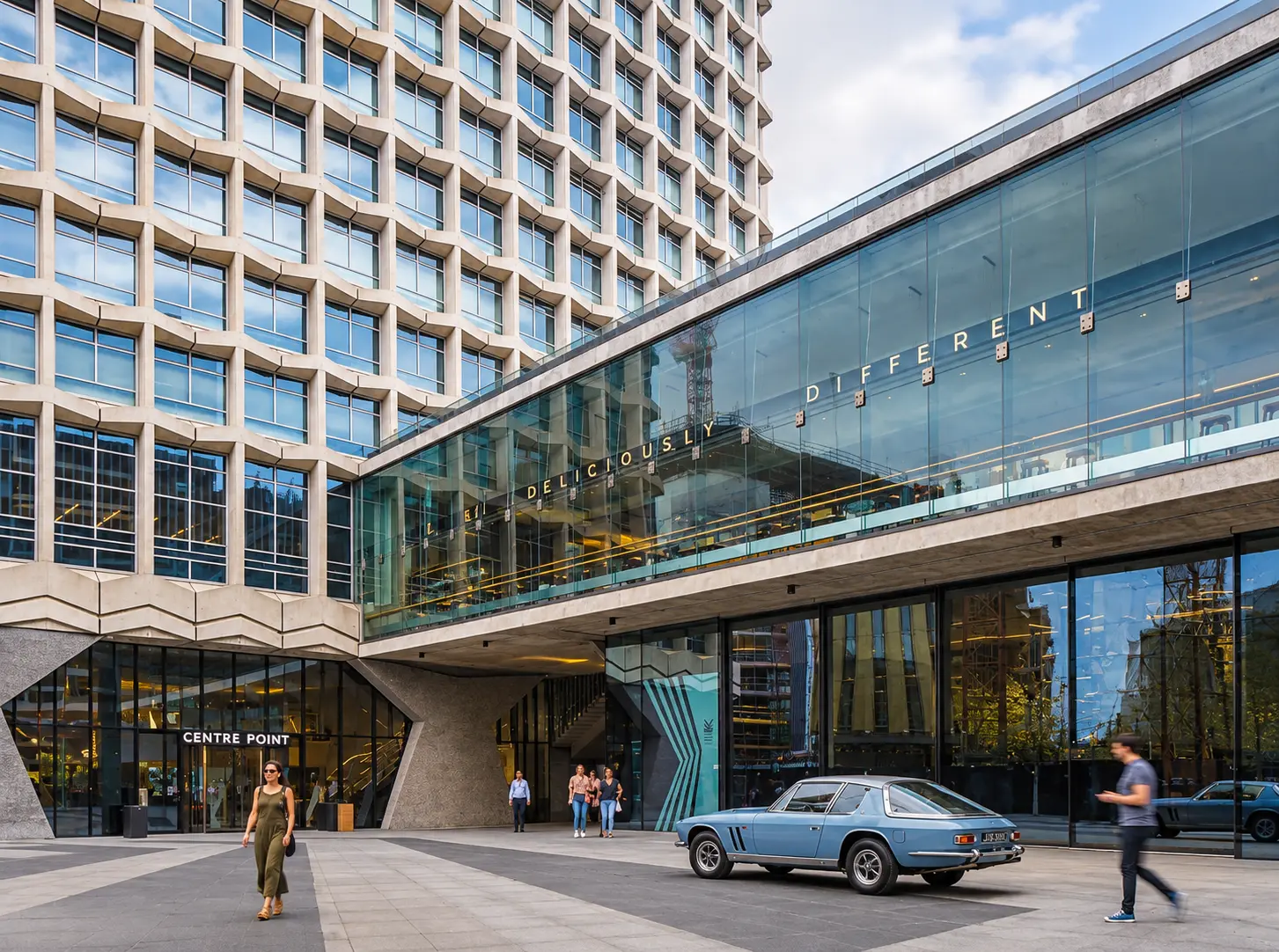

Landlords cannot recover the cost of certain unsafe cladding remediation from qualifying leaseholders simply because the building defect falls outside the Building Safety Act 2022’s 30-year definition of a “relevant defect”, the Court of Appeal has confirmed in a significant service-charge ruling concerning Centre Point House in London.
What did the Court of Appeal decide?
In Almacantar Centre Point Nominee No.1 Limited and another v Penelope Claire de Valk and others [2026] EWCA Civ 1466, handed down on 17 November 2026, Lord Justice Newey and Lord Justice Fancourt delivered the judgment, with Lord Justice Miles agreeing. The Court dismissed the appeal brought by the freehold owners of Centre Point House.
The central issue was whether paragraph 8 of Schedule 8 to the Building Safety Act 2022 prevented the owners from recovering service charges from leaseholders with qualifying leases for a proposed scheme to replace the building’s defective façade. The Court agreed with the First-tier Tribunal and Upper Tribunal that the relevant works constituted “cladding remediation” and that the qualifying leaseholders were protected from the charge.
The decision confirms that paragraph 8 is not expressly tied to the statutory definition of a “relevant defect”. It also rejects an attempt to read “unsafe” as meaning only combustible or fire-dangerous cladding.
What was the Centre Point dispute about?
The case concerned Centre Point House, part of the Centre Point development near the junction of Charing Cross Road and New Oxford Street. Its six-storey podium contains 36 duplex flats. The external east and west façades used an unusual timber-framed glazing system which allowed water to enter concealed parts of the construction. Over time, the timber deteriorated and rotted.
The freehold owners proposed installing a new steel stick curtain-wall system over the existing façade, fixed to the building’s concrete structural frame. The new system would include bespoke steel frames, double-glazed vision panels and insulated spandrel panels, leaving the existing timber elements non-structural. The estimated cost was more than £12 million, including VAT and professional fees.
In January 2023, the owners applied to the First-tier Tribunal for a determination under section 27A(3) of the Landlord and Tenant Act 1985 on whether service charges would be payable for the works and, if so, by whom. The tribunal found that the works fell within the owners’ repairing obligations and would in principle be recoverable through service charges. However, it held that leaseholders with qualifying leases were protected by paragraph 8 of Schedule 8. The Upper Tribunal dismissed the owners’ appeal in September 2025, leading to the appeal to the Court of Appeal.
- The freehold owners apply to the First-tier Tribunal for a service-charge determination.
- The Upper Tribunal dismisses the owners’ appeal against the First-tier Tribunal’s decision.
- The Court of Appeal hears the appeal.
- The Court of Appeal hands down judgment and dismisses the appeal.
All 13 respondents to the appeal held qualifying leases of flats in Centre Point House. The judgment records that other flats in the building were occupied by tenants without qualifying leases or were held by the appellants themselves.
Does paragraph 8 require a relevant defect?
The owners argued that paragraph 8 should be read as applying only where the cladding works remediate a “relevant defect” within section 120 of the Building Safety Act. That definition generally concerns defects arising from relevant works completed during the 30-year period ending when section 120 came into force on 28 June 2022. Centre Point House pre-dated that period, so the owners said the statutory protection could not apply.
The Court rejected that interpretation. Although sections 116 and 122 and several other paragraphs of Schedule 8 refer to relevant defects, paragraph 8 does not. It instead provides that no service charge is payable under a qualifying lease in respect of cladding remediation, defined as the removal or replacement of any part of a cladding system that forms the outer wall of an external wall system and is unsafe.
The Court considered the statutory wording, the structure of Schedule 8, the explanatory notes and the wider purpose of the legislation. It found no sufficient basis for adding a relevant-defect requirement that Parliament had not included in paragraph 8. The fact that other paragraphs in the schedule are linked expressly to relevant defects did not justify reading the same restriction into paragraph 8.
Paragraph 8 of Schedule 8 is not limited to cladding remediation connected with a “relevant defect”.
The Court also rejected the suggestion that the provision contained an obvious drafting error that could be corrected by interpretation. The strict conditions for judicial correction of statutory wording, explained in Inco Europe Ltd v First Choice Distribution, were not met. Ground 1 therefore failed.
What does “unsafe” cladding mean?
The owners submitted that “unsafe” in paragraph 8(2)(b) should be confined to cladding that is combustible or contributes to the spread of fire. They relied on the Building Safety Act’s origins in the Grenfell Tower fire and on the statutory definition of “building safety risk”, which refers to risks arising from the spread of fire or the collapse of a building or part of it.
The Court did not accept that narrow reading. It held that “unsafe” is an ordinary English word meaning involving danger. Parliament could have expressly restricted paragraph 8 to fire risks, or used the defined term “building safety risk”, but it did not do so. The Act was not exclusively concerned with fire, and cladding can cause harm in other ways.
On the facts, the façade’s defective design allowed water ingress, leading to deterioration and rot in the timber members. The Court therefore rejected the argument that the protection could only apply to cladding presenting a fire risk. Ground 5 failed.
Why did the cladding grounds fail?
The owners also challenged the tribunal’s findings that the façade comprised cladding, that the proposed scheme involved removing or replacing part of a cladding system, and that the system formed the outer wall of an external wall system.
Ground 2 – whether the façade was cladding: The Court treated the question of whether the building included a cladding system, and what it comprised, as a factual matter for the specialist First-tier Tribunal. The tribunal had heard expert evidence and considered the construction of the façade. It had found that the timber frame, glazing, windows, spandrel panels, insulation and associated fixings formed the cladding system. The concrete structure and dwarf walls were parts of the wider external wall system but were not part of that cladding system. There was no basis for the appellate court to interfere with that factual assessment as an error of law.
Ground 3 – whether there was removal or replacement: The proposed works involved removing substantial parts of the existing system, including glazing, windows and frames, spandrel panels, insulation, fixings and part of the timber frame, and replacing much of it with a modern steel-framed glazing system. The Court held that the tribunal was entitled to find that this amounted to removal and replacement within paragraph 8(2). Ground 3 was dismissed.
Ground 4 – whether the cladding formed the outer wall: The owners argued that the cladding system could not qualify if it was the same thing as the external wall system. The Court did not need to decide the broader question of whether a cladding system that constitutes the whole external wall system can ever fall within paragraph 8. On the facts found by the First-tier Tribunal, the cladding system and the external wall system were not identical: the dwarf walls and parts of the concrete structure formed part of the wider external wall system but were outside the cladding system. The tribunal was therefore entitled to conclude that the cladding system formed the outer wall of an external wall system. Ground 4 failed.
What issue did the Court leave open?
The Court expressly reserved the question of whether a cladding system that makes up the whole of a building’s external wall system can qualify as a cladding system for paragraph 8(2). It described that as a question that may be important in a future case, but said it was unnecessary to decide it on the construction facts before the Court.
This means the judgment should not be read as resolving every boundary question about curtain-walling or single composite external walls. Its conclusion was tied to the First-tier Tribunal’s factual findings about Centre Point House, where the cladding system was only part of the wider external wall system.
What does the judgment mean for leaseholders and landlords?
For leaseholders with qualifying leases, the decision confirms that paragraph 8’s protection against service charges for unsafe cladding remediation is not automatically restricted to defects created within the 30-year period used by the separate “relevant defect” definition. The statutory wording and the character of the proposed works remain central.
For landlords and managing agents, the judgment underlines the importance of analysing paragraph 8 on its own terms. The questions include whether the works remove or replace any part of a cladding system, whether that system forms the outer wall of an external wall system, and whether it is unsafe. The factual and expert evidence about the building’s construction may be decisive.
The ruling does not mean that every façade repair or external-wall project is automatically “cladding remediation”. Nor does it determine the treatment of leases that do not qualify for Schedule 8 protection. The Court dismissed the appeal on all five grounds and upheld the result reached by the tribunals.
Frequently asked questions
Can landlords charge qualifying leaseholders for unsafe cladding remediation?
Paragraph 8 of Schedule 8 to the Building Safety Act 2022 provides that no service charge is payable under a qualifying lease in respect of cladding remediation as defined in that paragraph. Whether particular works fall within the definition depends on the facts and the statutory wording.
Must the cladding defect be a “relevant defect” under section 120?
No. The Court of Appeal held that paragraph 8 is not limited to remediation connected with a “relevant defect”. The paragraph does not contain that requirement.
Does “unsafe” mean only a fire risk?
No. The Court held that “unsafe” carries its ordinary meaning of involving danger and is not confined to combustible cladding or the spread of fire.
Did the Court decide that all curtain-wall systems are covered?
No. It expressly left open whether a cladding system that constitutes the whole of an external wall system can fall within paragraph 8(2). The decision was based on the particular factual findings about Centre Point House.
Was the landlords’ appeal successful?
No. The Court of Appeal dismissed the appeal on all five grounds, leaving in place the tribunal outcome protecting the respondents’ qualifying leases from the proposed cladding-remediation service charges.