
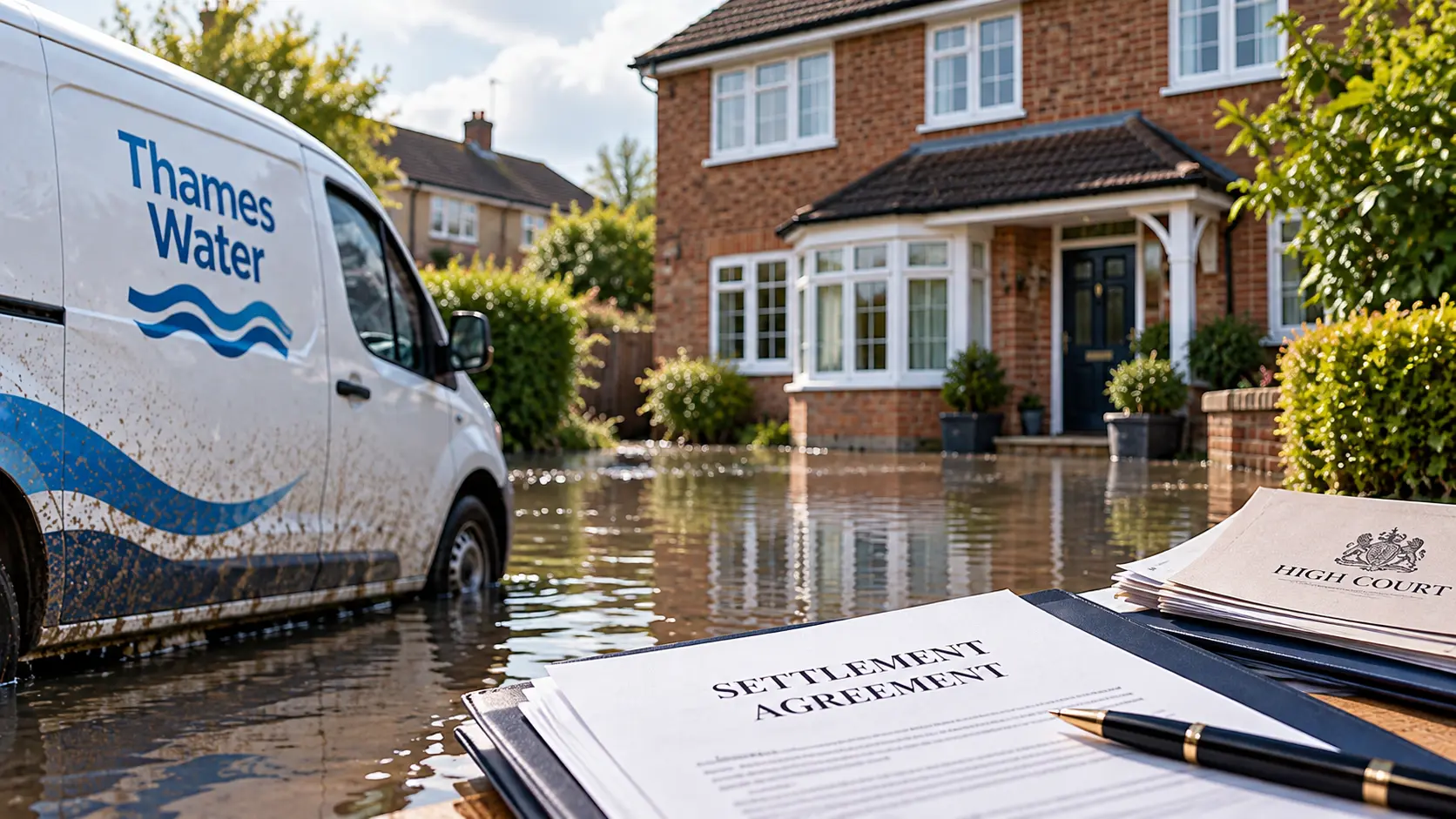

The High Court has ruled in favour of Thames Water Utilities Limited in a fraud claim concerning a £225,000 settlement paid to Karen Imber following a long-running dispute over sewage flooding at her home. The judgment underlines the importance of correcting a representation when circumstances change materially during settlement negotiations.
What did the High Court decide?
In Thames Water Utilities Limited v Karen Imber [2026] EWHC 2720 (KB), handed down on 23 October 2026, Deputy Master Marzec considered Thames Water’s application for summary judgment in a claim for fraudulent misrepresentation.
The claimant sought to set aside a settlement agreement and recover the £225,000 it had paid to Mrs Imber. It argued that statements describing the property as unsaleable had become misleading once the property was sold, but were not corrected before the parties reached their settlement.
The court concluded that Thames Water had no realistic prospect of failing to establish misrepresentation, reliance and dishonesty. Summary judgment was therefore entered in the claimant’s favour. The court rescinded the settlement agreement and ordered Mrs Imber to repay the settlement sum. Any further damages claimed by Thames Water would need to be assessed separately.
How did the dispute arise?
Mrs Imber’s home in Woodford Green, Essex, was flooded by sewage water in 2006 and 2007. She brought proceedings against Thames Water, which were settled in 2013 with a payment of £500,000 in full and final settlement.
The property was flooded again in 2014. Mrs Imber brought a further claim for losses that she said were not insured. In support of that claim, an expert report valued the property at £817,000 on the hypothetical basis that it had no history of flooding. The report also stated that there was likely to be no willing buyer for the property.
In a mediation statement dated 11 July 2023, Mrs Imber described herself as “trapped” in the property and said it was “unsaleable”. She claimed diminution in market value of £817,000, alongside other losses relating to relocation, insurance premiums, mortgage payments, legal costs, distress and inconvenience.
Following negotiations, the parties agreed a settlement of £180,000 plus £45,000 in costs. A settlement deed was entered into on 6 September 2023, and the total £225,000 was paid on 13 September 2023.
Why was the property sale important?
At the time of the settlement, Thames Water did not know that Mrs Imber had accepted an offer of £780,000 for the property before the mediation. Contracts were exchanged on 2 August 2023 and the sale completed the following day.
The sale price was approximately £37,000 below the £817,000 valuation given by her expert on the assumption that the property had no history of flooding. Thames Water later argued that the completed sale contradicted the central assertion that the property was unsaleable.
The completed sale fundamentally changed the factual basis on which the diminution-in-value claim had been advanced.
The court held that although the statement that the property was “unsaleable” could be viewed as an opinion, it implied factual representations that the property had not been sold and that no sale was expected. Those implied representations became false when the sale completed.
The judge also rejected the argument that Thames Water’s earlier position—that the property could be sold—meant the actual sale could not have influenced the settlement. The fact that the property had in fact been sold was material to the negotiations, regardless of whether Thames Water accepted Mrs Imber’s earlier assessment of its saleability.
How did the court assess dishonesty?
The court applied the approach to dishonesty set out by the Supreme Court in Ivey v Genting Casinos UK Ltd. The fact-finder must first establish the individual’s actual knowledge or belief about the facts, then assess the conduct against the objective standards of ordinary decent people.
Mrs Imber’s case was that she had disclosed the accepted offer to the mediator and believed that the information had been passed to Thames Water. She also said she did not expect the sale to complete because she anticipated difficulties with insurance. She maintained that she later told her solicitor about the completed sale when she reviewed the settlement deed.
For the summary judgment application, the court considered the defendant’s account on the assumed basis that it was accurate. However, the judge found that disclosure of the sale to her solicitor after the settlement agreement had been made did not correct the representation to Thames Water during the negotiations.
The court distinguished between an accepted offer, which may not lead to a completed transaction, and a completed sale. By 3 August 2023, Mrs Imber knew that the property had sold for £780,000 and that she was moving out. In the court’s assessment, this was a fundamental change, not a peripheral development.
The judge concluded that ordinary decent people would regard it as dishonest to continue pursuing and settling a claim based on a property being unsaleable after it had in fact been sold, without informing the opposing party. The defendant therefore had no realistic prospect of resisting a finding of dishonesty at trial.
What does the judgment mean for settlement negotiations?
The judgment highlights the need for parties to ensure that material factual representations remain accurate throughout settlement negotiations. Where a claim relies heavily on a particular factual premise, a significant change to that premise may require the party advancing the claim to correct the position before an agreement is reached.
For solicitors advising clients in ongoing disputes, the case also demonstrates the importance of promptly communicating material developments, including completed property transactions, changes in losses and other events that could affect the value or basis of a claim.
The decision was made on an application for summary judgment. The court concluded that the defendant had no realistic prospect of defending the claim on the issues of misrepresentation, reliance and dishonesty. Thames Water’s claim for any additional damages remains subject to assessment if pursued.
Frequently asked questions
What was the case about?
The case concerned Thames Water’s claim that Karen Imber had failed to correct statements about her property being unsaleable after it had been sold, before the parties entered into a £225,000 settlement agreement.
How much was the settlement?
The settlement totalled £225,000, comprising £180,000 plus £45,000 in costs.
How much was the property sold for?
The property was sold for £780,000, with completion taking place on 3 August 2023.
What remedy did the High Court order?
The court rescinded the settlement agreement and ordered the defendant to repay the £225,000 settlement amount. Any further damages claimed by Thames Water would need to be assessed.
Which court heard the case?
The case was heard in the High Court of Justice, King’s Bench Division, before Deputy Master Marzec. The judgment was handed down on 23 October 2026.