
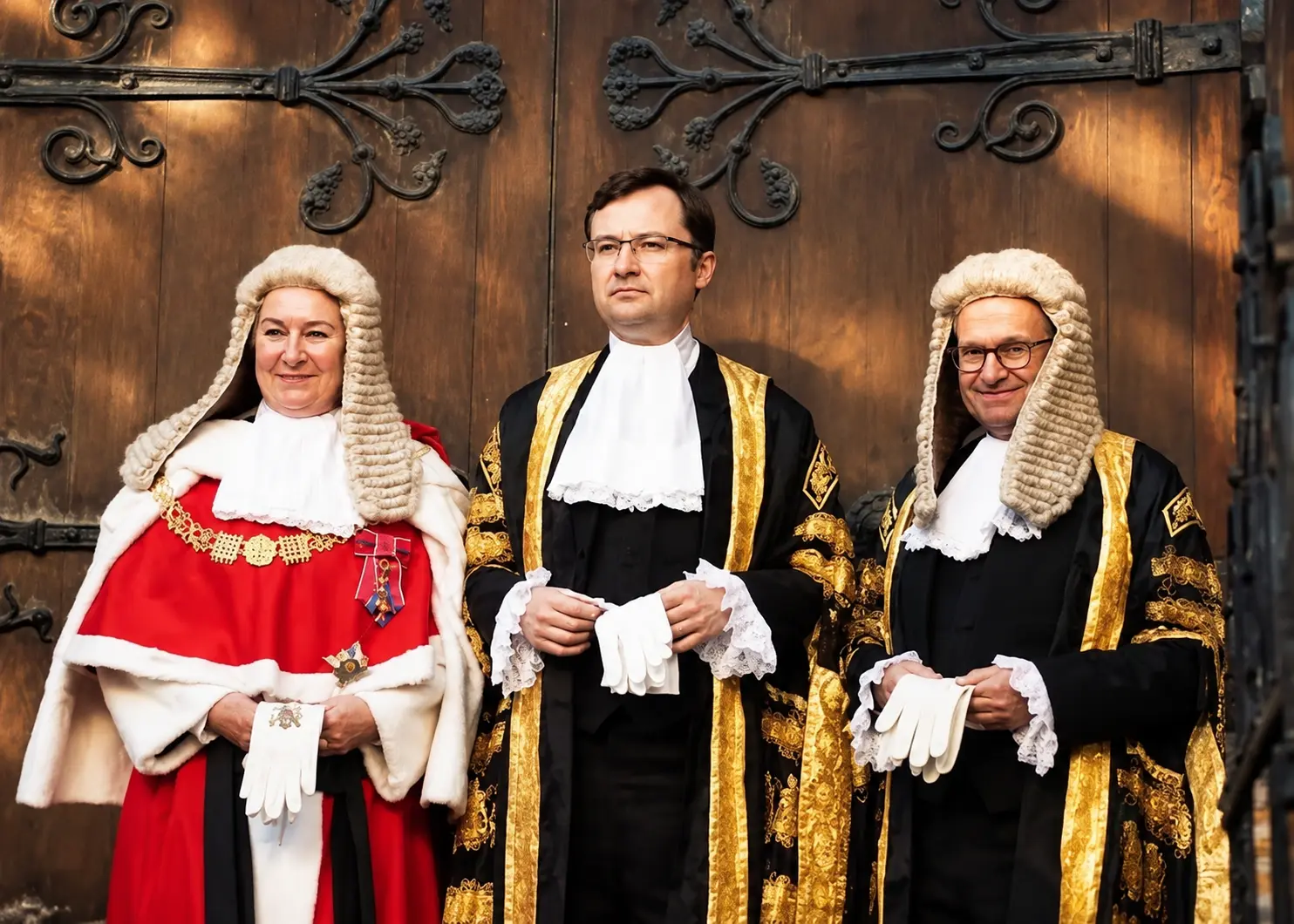

The Right Honourable Alex Norris MP has been formally sworn in as Lord Chancellor at the Royal Courts of Justice, beginning a new chapter in the constitutional relationship between Government and the judiciary.
What happened at the swearing-in?
The Right Honourable Alex Norris MP was sworn in as Lord Chancellor and Secretary of State for Justice at the Royal Courts of Justice on 1 October 2026, the first day of the new legal year. His appointment followed his appointment to the office in July, having previously served as Minister of State at the Home Office.
The ceremony was conducted by the Lady Chief Justice of England and Wales, the Right Honourable the Baroness Carr of Walton-on-the-Hill. The ceremony also included the swearing-in of the Attorney General, the Right Honourable Ellie Reeves MP, and Andy Slaughter MP as Solicitor General.
Baroness Carr welcomed Mr Norris, his family, friends and members of his Nottingham constituency team to the Royal Courts of Justice before addressing the constitutional importance of the occasion.
Why is the swearing-in significant?
The Lord Chancellor has already taken the statutory oath before His Majesty The King, as required by the Constitutional Reform Act 2005. The additional ceremony before the judiciary is therefore not a second statutory oath or a simple reaffirmation.
Baroness Carr described the ceremony as a well-established constitutional convention. She noted that each Lord Chancellor since Sir Jack Straw was sworn in before the judiciary in 2007 has followed the convention, including during the Covid-19 pandemic.
“Taking the oath here, today, once more affirms – publicly – the particular, the fundamental relationship that the Lord Chancellor has with the judiciary.”
— Baroness Carr of Walton-on-the-Hill, Lady Chief Justice
The Lady Chief Justice linked that relationship directly to the Lord Chancellor’s statutory duty to defend judicial independence. She said the duty includes speaking publicly in defence of judicial independence whenever necessary.
What is significant about Norris’s appointment?
Alex Norris is the first non-lawyer Lord Chancellor in a Labour Government. Baroness Carr noted that there have been five non-lawyers appointed to the office since 2005, with four serving consecutively between 2012 and 2018. Norris is the first non-lawyer to hold the office since 2018.
| Issue | Significance | Position |
|---|---|---|
| Swearing-in | Reflects an established constitutional convention between the Lord Chancellor and judiciary. | The ceremony was held before the judiciary at the Royal Courts of Justice. |
| Professional background | Norris is a non-lawyer entering an office with significant constitutional responsibilities. | He is the first non-lawyer Lord Chancellor in a Labour Government. |
| Judicial independence | The office has a statutory duty connected to protecting the independence of the judiciary. | The Lady Chief Justice highlighted the importance of that responsibility. |
What is Alex Norris’s background?
Alex Norris studied politics and history at the University of Nottingham. He subsequently served on Nottingham City Council as portfolio holder for Adults and Health while working as an Area Organiser for UNISON.
He was first elected to Parliament for Nottingham North in 2017 and was re-elected in 2019. Following constituency changes, he was elected in 2024 as MP for Nottingham North and Kimberley.
His parliamentary career has included a range of ministerial and opposition roles. He served as Parliamentary Private Secretary to the Shadow Health Secretary from 2017 to 2019 before becoming an Opposition Whip. He later served as Shadow Minister for Prevention, Public Health and Primary Care, acting Shadow Minister for the Department of International Development and Shadow Minister for Policing.
Following the 2024 General Election, Norris became Parliamentary Under-Secretary of State for Building Safety, Fire and Local Growth before becoming Minister of State for Border Security and Asylum in 2025.
Baroness Carr said his experience across local and national politics gave him an understanding of preventative care, policing, international development and the importance of a properly functioning, accessible and fair justice system.
What is the role of the Lord Chancellor?
The office of Lord Chancellor has an active constitutional role in maintaining the rule of law. The Judiciary states that Lord Chancellors must defend the independent judiciary and ensure that judges have the necessary support to carry out their work.
The Constitutional Reform Act 2005 changed the nature of the office. Historically, the Lord Chancellor could sit as a judge and exercise judicial functions. Following the reforms, the Lord Chancellor is no longer a judge and active judicial functions were transferred to the judiciary, particularly the Lady Chief Justice.
The reforms strengthened the separation of powers while retaining important responsibilities for the Lord Chancellor in defending the rule of law within Government.
The Lady Chief Justice also emphasised that the proper administration of justice depends upon constitutional co-operation between Government and the judiciary. This includes areas such as the management of His Majesty’s Courts and Tribunals Service, judicial appointments and discipline, alongside the protection of judicial independence.
Who else was sworn in?
The ceremony also marked the formal swearing-in of the Attorney General and Solicitor General.
The Right Honourable Ellie Reeves MP was sworn in as Attorney General, having previously served as Solicitor General. In her career before entering politics, she was called to the Bar by Inner Temple in 2004 and practised as an employment law specialist before establishing a legal consultancy focused on assisting women with discrimination issues.
Andy Slaughter MP was sworn in as Solicitor General. He studied English at Exeter University and was called to the Bar by Middle Temple in 1993. He practised at the Bar before moving increasingly into national politics and later serving as Chair of the Justice Select Committee.
Baroness Carr concluded by wishing all three office-holders well and emphasising the importance of their respective constitutional roles in defending and upholding the rule of law.
Frequently asked questions
When was Alex Norris sworn in as Lord Chancellor?
Alex Norris was sworn in as Lord Chancellor at the Royal Courts of Justice on 1 October 2026, the first day of the new legal year.
Who conducted the swearing-in ceremony?
The ceremony was conducted by the Lady Chief Justice of England and Wales, the Right Honourable the Baroness Carr of Walton-on-the-Hill.
Why is the ceremony before the judiciary significant?
Although the Lord Chancellor’s statutory oath is taken before His Majesty The King, the ceremony before the judiciary is an established constitutional convention. It publicly affirms the relationship between the Lord Chancellor and the judiciary and the office’s responsibility to defend judicial independence.
Is Alex Norris a lawyer?
No. Alex Norris studied politics and history at the University of Nottingham. His appointment makes him the first non-lawyer Lord Chancellor in a Labour Government.
What is the Lord Chancellor’s constitutional role?
The Lord Chancellor has important responsibilities for maintaining the rule of law, defending judicial independence and ensuring that the judiciary has the support necessary to carry out its work.
Who else was sworn in at the ceremony?
The Right Honourable Ellie Reeves MP was sworn in as Attorney General and Andy Slaughter MP was sworn in as Solicitor General.