11 C
London
Sunday, March 22, 2026
11 C
London
Sunday, March 22, 2026
Sign up for Newsletter

SQE HUB

What does a solicitor do?
How to become a solicitor?
Who is the SQE For?
Taking the SQE Assessments
QWE
What happens after you pass the SQE?
Sample Q/A

What does a solicitor do?

Solicitors provide clients with expert legal advice and represent them in a wide range of matters, including appearances before lower courts and tribunals.

For many individuals, organisations, and businesses, a solicitor is the first point of contact when legal guidance or representation is needed.

Solicitors work closely with barristers, preparing cases and legal documentation for hearings in higher courts. Their role involves understanding each client’s unique situation and offering tailored, practical solutions.

Once qualified, solicitors can choose to specialise in an area of law that aligns with their interests , from family law and medical law to international human rights or commercial practice.

As law influences every aspect of society, there are virtually limitless opportunities to specialise and build a rewarding career.

A Day in the Life of a Solicitor

The day-to-day work of a solicitor depends largely on the type of organisation they work for and the area of practice they specialise in.

Whether in private practice, the public sector, or in-house legal teams, solicitors handle a broad variety of tasks that require analytical thinking, client care, and attention to detail.

A typical day in the life of a solicitor might include:

  • Drafting and reviewing legal documents, such as contracts, agreements, and witness statements
  • Advising clients on complex legal issues and identifying the best course of action
  • Attending client meetings and negotiations to reach settlements or clarify legal positions
  • Researching case law, legislation, and legal precedents to support ongoing matters
  • Representing clients in court or tribunals, depending on the nature of the case
  • Undertaking pro bono work, providing free legal assistance to individuals or communities in need

Each day presents new challenges ,from negotiating deals to preparing cases for trial , making the solicitor’s role both intellectually stimulating and professionally rewarding.

Myth
“The SQE is easier than the LPC.”
Facts
The SQE is not easier — it is simply different. It’s competency-based, heavily scenario-focused, and tests practical application of knowledge. Many candidates find SQE1’s multiple-choice format very challenging.

The Benefits of Becoming a Solicitor

Solicitors play an essential role in society, advising clients on matters that affect nearly every aspect of life — from managing businesses and resolving disputes to buying property or planning estates.

This makes the solicitor’s role highly respected and deeply valued within the legal system and beyond.

Some key benefits of becoming a solicitor include:

Financial Rewards

Solicitors enjoy competitive salaries that reflect their expertise and responsibility. According to Prospects.ac.uk, starting salaries for trainee solicitors range from £28,000 to £68,000, depending on firm size and location. With experience and progression, senior solicitors and partners can earn significantly more.

Diverse and Engaging Work

No two days are alike. Solicitors interact with clients from all walks of life and work on cases that are dynamic, challenging, and socially relevant. The variety of work ensures continuous learning and personal growth.

Clear Career Progression

The solicitor career path is well-structured and merit-based. Ambitious individuals can advance from trainee solicitor to associate, and eventually to partner or head of department roles within firms or move into high-level in-house or government positions.

A Meaningful and Rewarding Career

Above all, solicitors make a tangible difference in people’s lives. From helping families through sensitive issues like divorce or wills to guiding businesses through major transactions, solicitors play a crucial role in upholding justice and providing support during life’s most important moments.

Key Takeaway

A career as a solicitor offers an exceptional balance of intellectual challenge, professional respect, and personal fulfilment.

It’s a path that combines financial stability, diverse experiences, and the opportunity to make a lasting impact on clients, communities, and society.
How to become a solicitor ?

The Solicitors Regulation Authority (SRA) is the independent regulatory body responsible for overseeing all solicitors and law firms in England and Wales.

Its primary role is to protect the public by ensuring that every solicitor upholds the same professional standards, ethical principles, and code of conduct.

The SRA sets the rules for qualification, monitors professional behaviour, and takes action where those standards are not met.

In addition, the SRA determines the education and training requirements for becoming a solicitor including the introduction and management of the Solicitors Qualifying Examination (SQE) and ensuring that all solicitors entering the profession are competent, honest, and fit to practise.

What Is the Solicitors Qualifying Examination (SQE)?

Introduced by the Solicitors Regulation Authority (SRA) in September 2021, the Solicitors Qualifying Examination (SQE) is the new centralised assessment for anyone wishing to qualify as a solicitor in England and Wales.

The SQE replaces the former Legal Practice Course (LPC) as the standard route to qualification.

Unlike the LPC, which was a course of study, the SQE is a set of professional examinations designed to assess both legal knowledge and practical skills required for competent practice.

To qualify as a solicitor through the SQE route, you must complete the following four key steps:

  • Hold an undergraduate degree (or equivalent) — this can be in any subject
  • Pass both SQE1 and SQE2 assessments, which evaluate your legal knowledge and practical skills.
  • Complete at least two years of Qualifying Work Experience (QWE) — gained across one or more organisations, such as law firms, in-house legal teams, or clinics.
  • Meet the SRA’s character and suitability requirements, demonstrating honesty, integrity, and professionalism.
Myth
“You must complete SQE1 and SQE2 at the same training provider.”
Facts
You can choose different providers for SQE1 and SQE2 preparation. The SRA does not mandate a single training route.

Who is the SQE For?

One of the key reasons behind the introduction of the Solicitors Qualifying Examination (SQE) was to make the route to becoming a solicitor more inclusive and accessible to everyone — regardless of background, education, or career stage.

Whether you’ve always aspired to a legal career or are now considering a transition into law from another profession, the SQE provides a flexible and standardised pathway to qualification in England and Wales.

Below, you’ll find how the SQE applies to different types of candidates:

If You’re a Law Graduate (LLB Holder)

If you have completed an undergraduate law degree (LLB) and already have a solid grounding in legal principles, you can progress directly to preparing for the SQE1 and SQE2 assessments.

You have two main study options:

  • SQE Preparation Course: Focused training designed to help you pass the SQE assessments efficiently.
  • Master’s with SQE Preparation: Ideal if you want to strengthen both your academic knowledge and professional skills while enhancing employability.

In addition to passing both SQE stages, you must complete two years of Qualifying Work Experience (QWE) to qualify as a solicitor.

If You’re a Graduate in a Non-Law Subject or Changing Careers

Coming from a non-law background can actually be an advantage — employers often value the diverse perspectives and transferable skills that non-law graduates bring to the legal profession.

However, to undertake the SQE1 and SQE2 assessments, you’ll first need to gain a solid understanding of core legal principles.

To do this, most candidates complete a law conversion course such as a Graduate Diploma in Law (GDL) or a Postgraduate Diploma in Law (PGDL).

Once you’ve completed your conversion course, you can:

  • Begin preparing for the SQE assessments
  • Start accumulating two years of QWE, which can be completed before, during, or after the exams

If You’re Already Working in the Legal Sector

If you’re already employed in a legal or paralegal role, you may be closer to qualification than you think.

You can prepare directly for the SQE assessments, and your existing legal experience may count toward your Qualifying Work Experience (QWE) requirement.

Some candidates also choose to take a short SQE Law Essentials course to refresh their academic understanding before sitting the exams.

If You’re an Internationally Qualified Lawyer

If you’re a lawyer qualified in another jurisdiction, the SQE offers a clear route to practise as a solicitor in England and Wales.

You will need to pass the SQE1 and SQE2 assessments, although the SRA may grant exemptions based on your jurisdiction and professional experience.

As a qualified lawyer, you may also be exempt from completing the two years of Qualifying Work Experience.

For detailed guidance on eligibility and exemptions, visit the SRA’s official website.

Myth
“The SQE is only for new graduates.”
Facts
The SQE route is open to anyone with a degree (any subject) or an equivalent qualification. Many career changers and mature learners successfully follow this route.
Myth
“Everyone must complete formal training before taking the SQ.”
Facts
Training courses are optional. You may self-study, use textbooks, or combine resources — as long as you pass the SRA exams.

Taking the SQE Assessments

Unlike the previous Legal Practice Course (LPC), the Solicitors Qualifying Examination (SQE) is set and regulated directly by the Solicitors Regulation Authority (SRA) — not by universities or legal education providers.

This ensures that every aspiring solicitor in England and Wales is assessed against the same consistent national standard, regardless of where or how they choose to study.

Each stage of the SQE is designed to test different areas of legal knowledge and professional skill essential for competent practice.

Both SQE1 and SQE2 assessments are conducted under strict examination conditions at Pearson VUE test centres across the UK and internationally.

To take the exams, candidates must:

  • Book directly through the SRA’s online portal when registration opens
  • Select a test centre location and date that suits them
  • Wait for an official confirmation email from the SRA, detailing the assessment venue, date, time, and duration

The SRA provides all administrative details, ensuring a fair and transparent process for every candidate.

Myth
“You cannot attempt SQE2 without passing SQE1.”
Facts
For domestic candidates, yes, SQE2 requires SQE1 first — but foreign-qualified lawyers may be eligible to take SQE2 directly, depending on SRA exemptions.

SQE1:

The SQE1 assessment is the first stage of the Solicitors Qualifying Examination (SQE) and is designed to test your Functioning Legal Knowledge (FLK) — your ability to identify key legal principles and apply them accurately and effectively to practical client scenarios.

The assessment is divided into two parts : FLK1 and FLK2 — each covering different areas of law and legal practice. Both exams are closed-book multiple-choice tests, consisting of 180 questions, each offering five options with one single best answer.

In essence, SQE1 evaluates not only what you know about the law but also how you apply that knowledge in real-world legal contexts, reflecting the analytical and problem-solving.

FLK1 CoversFLK2 Covers
  • Business Law and Practice
  • Dispute Resolution
  • Contract Law
  • Tort Law
  • The Legal System of England and Wales, including Constitutional and Administrative Law, and EU Law
  • Legal Services
  • Property Practice
  • Wills and the Administration of Estates
  • Solicitors’ Accounts
  • Land Law
  • Trusts
  • Criminal Liability
  • Criminal Law and Practice
FLK1 Covers
  • Business Law and Practice
  • Dispute Resolution
  • Contract Law
  • Tort Law
  • The Legal System of England and Wales, including Constitutional and Administrative Law, and EU Law
  • Legal Services
FLK2 Covers
  • Property Practice
  • Wills and the Administration of Estates
  • Solicitors’ Accounts
  • Land Law
  • Trusts
  • Criminal Liability
  • Criminal Law and Practice

SQE1 Written Assessment Schedule

The SQE1 is taken over two consecutive days, with each day including two examination sessions:

Day 1
Session 1
2 hours 33 minutes
Scheduled break
60 minutes
Session 2
2 hours 33 minutes
Day 2
Session 1
2 hours 33 minutes
Scheduled break
60 minutes
Session 2
2 hours 33 minutes

SQE2

The SQE2 assessment tests your ability to perform the core practical legal skills required of a solicitor. It focuses heavily on professionalism, ethics, and client care, ensuring you can apply your legal knowledge effectively in real-world practice.

Where SQE1 measures what you know, SQE2 measures what you can do — how well you apply your understanding, analysis, and reasoning to solve complex legal problems.

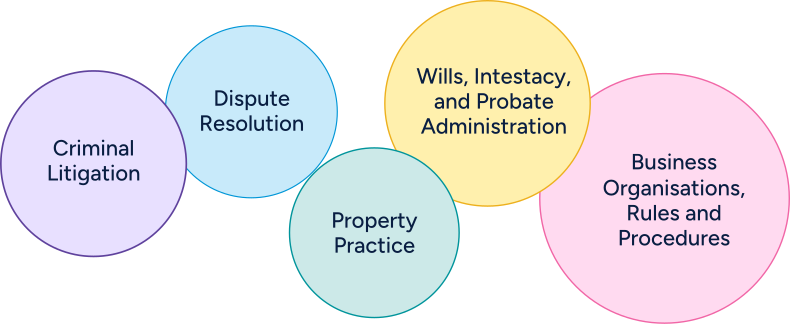
You will also be assessed in specific practice areas which are:

SQE2 Oral Assessment Schedule

DayTime WindowCandidate AttendanceAssessmentsPractice Areas
18:00 AM – 8:00 PM4.5 to 7 hours (within the window) • Advocacy
• Interview & Attendance Note / Legal Analysis
• Dispute Resolution
• Property Practice
28:00 AM – 8:00 PM4.5 to 7 hours (within the window) • Advocacy
• Interview & Attendance Note / Legal Analysis
• Criminal Litigation
• Wills and Intestacy, Probate Administration and Practice

SQE2 Written Assessment Schedule

DaySessionDurationScheduled BreakPractice Areas
1 Session 1
Session 2
1 hour 30 minutes
1 hour 45 minutes
15 minutes
--
Dispute Resolution

Criminal Litigation
2 Session 3
Session 4
1 hour 30 minutes
1 hour 45 minutes
15 minutes
--
Property Practice

Wills and Intestacy,
Probate Administration and Practice
3 Session 5
Session 6
1 hour 30 minutes
1 hour 45 minutes
15 minutes
--
Business Organisations, Rules and Procedures

Business Organisations, Rules and Procedures (continued)

Note

  • Candidates will receive exact timings and venue details from the Solicitors Regulation Authority (SRA) prior to their assessment dates.
  • All information above is accurate as of April 2025 and may be subject to change.

For the most up-to-date details, visit the official SRA website.

How much do the SQE assessments cost?

The fees for the Solicitors Qualifying Examination (SQE) are set by the Solicitors Regulation Authority (SRA) and apply to all candidates taking the assessments.

For assessments taken from September 2025 onwards, the fees are as follows:

SQE1
£1,934
(£967 for FLK1 and £967 for FLK2)
SQE2
£2,974

Important

These fees are determined by the SRA and are subject to change.
For the most accurate and up-to-date information on SQE assessment costs, visit the official SRA website.

Results and Resits

You will receive your SQE1 results approximately five to six weeks after sitting the assessments, while SQE2 results are released around 14 to 18 weeks after completion.

These timeframes allow for detailed marking, moderation, and quality assurance by the Solicitors Regulation Authority (SRA) to ensure fairness and consistency across all candidates.

Resits and Attempt Limits

If you do not pass an assessment, you are permitted to resit both SQE1 and SQE2. However, the following rules apply:

  • You can attempt each assessment up to three times (i.e., three attempts for SQE1 and three attempts for SQE2).
  • All attempts must be completed within six years of the date you first sit your initial SQE assessment.

This six-year time limit ensures that your legal knowledge and practical skills remain current throughout your qualification journey.

What is QWE?

QWE aims to be a more flexible approach than the current period of recognised training, commonly referred to as a ‘training contract’.

QWE gives candidates the opportunity to:

  • interact with clients
  • see how solicitors work in practice
  • consider ethical challenges
  • develop competences
Myth
““QWE must be completed in one law firm.”
Facts

You can complete QWE in up to four organisations, including:

  • law firms
  • in-house legal teams
  • NGOs or charities
  • law clinics
  • alternative legal service providers

This makes the route more flexible than the traditional training contract.

Requirements for Qualifying work experience

  • All candidates will need to complete at least two years full-time (or equivalent) qualifying work experience (QWE).
  • There is no minimum length of time for placements. QWE could include summer work placements or work as a paralegal so long as it’s signed off.
  • While it is not necessary to evidence every competence set out by the Solicitors Regulation Authority (SRA), candidates must be able to demonstrate the development of at least two core competencies from the SRA framework
Myth
“You must complete QWE before taking the SQE exams.”
Facts
You can complete QWE before, during, or after your SQE exams. There is no fixed order as long as all components are completed before you apply for admission.

Structure of Qualifying Work Experience (QWE)

The structure of QWE is determined by the individual firm or organisation providing the placement. This means experiences can vary significantly in length and format:

  • Some organisations may offer only a short placement contributing to the overall requirement.
  • Others may provide the full two years of QWE needed for qualification.

Employer Responsibilities

To ensure QWE is meaningful and compliant, employers should:

  • Maintain accurate records of the work undertaken by the candidate.
  • Track and record competencies developed in line with the SRA’s Statement of Solicitor Competence.
  • Provide confirmation at the end of each placement, verifying both the duration and competencies gained.
Myth
“QWE must include rotations across departments.”
Facts
Rotations are optional. Even experience in one practice area counts as long as you develop competencies aligning with the SRA’s solicitor statement.

What’s the Difference Between QWE and a Training Contract?

Both Qualifying Work Experience (QWE) and the traditional training contract share the same ultimate goal — to help aspiring solicitors develop practical legal skills, apply their knowledge in real settings, and gain hands-on experience before qualifying.

However, the introduction of the SQE and QWE system has made this process far more flexible and accessible compared to the traditional training contract route.

QWE vs. Training Contract: A Comparison
AspectQualifying Work Experience (QWE)Training Contract
RoutePart of the SQE qualification pathwayPart of the LPC qualification route
StructureCan be completed across up to four organisations or employersCompleted entirely at one firm
Practice AreasOffers flexibility — you can gain experience in multiple practice areas or specialise in a single niche, depending on your preference or the organisation’s focusUsually involves rotations (“seats”) across different departments, though some firms focus on one practice area
TimingCan be completed at any stage of the qualification process — before, during, or after sitting SQE1 or SQE2 assessmentsTypically undertaken after completing the LPC
Record KeepingYou are responsible for tracking your QWE and recording the competencies you develop, which must be signed off by a solicitor of England and Wales or a COLPStructured and monitored internally by the training principal or supervisor within the firm
LocationCan be completed internationally, provided there is a UK-qualified solicitor available to confirm and sign off the experienceGenerally undertaken within the UK, under the supervision of an authorised law firm
Additional RequirementsDoes not require completion of the Professional Skills Course (PSC)Requires completion of the Professional Skills Course (PSC) before qualification
FlexibilityHighly flexible allows candidates to gain diverse legal experience in varied settings such as law firms, in-house teams, or legal clinicsMore traditional and structured — focused on firm-based training with defined supervision and rotations.
Myth
“Only solicitors can sign off QWE.”
Facts

Anyone regulated by a legal services body can sign off QWE — including:

  • solicitors
  • barristers
  • CILEX professionals
  • overseas lawyers (if supervised work aligns with the SRA competencies)

What happens after you pass the SQE?

After you’ve passed your SQE assessments and have met the other elements required by the SRA, you’ll be able to begin the process to admit yourself to the SRA’s roll of solicitors.

Assessment of Suitability

You’ll be questioned on your character and suitability to become a solicitor.

Screening

You’ll have to undergo several checks, including identity, financial and criminal.

Fee payment

You’ll need to pay the SRA a small fee to be admitted to the roll of solicitors.

Practising certificate

You can now apply for your first practising certificate online through the SRA.

Law Society membership

Once you’ve been admitted to the roll of solicitors, you’ll automatically become a member of the Law Society, a professional body for solicitors in England and Wales.

Admissions ceremony

The Law society will invite you to an admissions ceremony in Chancery Lane, London. This ia optional to attend.

Start practising

You can now start practising as a lawyer in England and Wales.

Myth
“QWE must be paid.”
Facts
No. QWE can be paid or unpaid. Many candidates complete QWE in voluntary roles such as university legal clinics or pro bono centres.
Myth
“QWE is the same as a training contract.”
Facts
A training contract counts as QWE, but QWE is broader and more flexible. It does not have to follow the traditional two-year structured programme.

Sample Question 1: Duties to the Court and Third Parties

Scenario

A solicitor specialising in criminal litigation represents a client charged with assault occasioning actual bodily harm.

The client maintains his innocence, pleads not guilty, and gives evidence in his own defence. Following the trial, the client is acquitted.

After the acquittal, the client privately admits to the solicitor that he was, in fact, guilty — meaning he committed perjury while giving evidence.

Question

Which of the following best describes the action the solicitor should now take?

Answer Options

1

Write to the court disclosing the client’s guilt, thereby fulfilling the duty to act with integrity.

2

Take no further action, as the knowledge of perjury was obtained after the trial and does not amount to complicity in misleading the court.

3

Contact the Crown Prosecution Service to request a retrial, thereby upholding the administration of justice.

4

Instruct the client to confess to the prosecution and warn that failure to do so will require the solicitor to withdraw.

5

Inform the victim that the client was guilty, thereby fulfilling the duty to act with honesty.

Correct Answer


Option 2: Take no further action, as the knowledge of perjury was obtained after the trial and does not amount to complicity in misleading the court.

Explanation

Option 2 accurately reflects the solicitor’s professional obligations.

Once proceedings have concluded, the solicitor’s knowledge of the client’s perjury does not make them complicit in misleading the court. Under Paragraph 1.4 of the SRA Code of Conduct for Solicitors, RELs and RFLs, solicitors must not mislead the court — but this duty applies only while proceedings are ongoing.

The solicitor remains bound by the duty of confidentiality (Paragraph 6.3) and must not disclose the client’s admission without consent or legal obligation.

Although the solicitor must act with integrity (SRA Principle 5) and uphold
the rule of law (Principle 1), these do not override the fundamental duty of confidentiality and acting in the client’s best interests (Principle 7).

Why the Other Options Are Incorrect

Option A: Disclosing the client’s guilt would breach confidentiality and the duty to act in the client’s best interests, contrary to SRA Principle 7.

Option C: Contacting the CPS would similarly breach confidentiality and is not legally required.

Option D: There is no obligation for the client to reveal guilt after acquittal; the solicitor’s role in the matter has concluded.

Option E: Contacting the victim would be a serious breach of confidentiality and professionalism, violating SRA Principle 4 (Honesty).

Key Learning Point

After criminal proceedings conclude, a solicitor’s duty of confidentiality continues — even when a client later admits wrongdoing.

The solicitor must not reveal that information unless required by law or authorised by the client.

Relevant SRA Principles & Provisions

Principle 1: Uphold the rule of law and the proper administration of justice.

Principle 4: Act with honesty.

Principle 5: Act with integrity.

Principle 7: Act in each client’s best interests.

SRA Code of Conduct: Paragraphs 1.4 and 6.3.

Sample Question 2: Duties to the Court and Third Parties

Scenario

A solicitor represents a client who has pleaded guilty to assaulting a member of staff in a public house.

At the sentencing hearing, the court asks the solicitor to confirm whether the client’s list of previous convictions is complete and accurate.

The solicitor notices that a prior conviction for assaulting a bartender the previous year has been omitted.

After advising the client that the list should be corrected, the client instructs the solicitor to confirm it as accurate regardless.

Question

Which of the following best explains what action the solicitor should take?

Answer Options

1

Inform the client that the solicitor must cease to act, as they cannot knowingly mislead the court.

2

Follow the client’s instruction, as the duty to act in the client’s best interests overrides the duty not to mislead the court.

3

Continue to act but inform the court that the list is inaccurate, as silence would breach the duty to uphold the proper administration of justice.

4

Correct the list, then cease to act, to fulfil the duty to uphold the administration of justice.

5

Continue to act but neither confirm nor deny the accuracy of the list, thereby avoiding misleading the court.

Correct Answer


Option 1: Inform the client that the solicitor must cease to act, as they cannot knowingly mislead the court.

Explanation

A solicitor must never knowingly mislead the court, even when acting on their client’s instructions.

Under Paragraph 1.4 of the SRA Code of Conduct for Solicitors, RELs and RFLs, the duty to the court and the proper administration of justice takes precedence over the duty to act in a client’s best interests.

If a client insists on a course of action that would mislead the court, the solicitor must refuse to comply and, if necessary, cease to act.

Disclosing the inaccuracy without the client’s consent would breach confidentiality, so withdrawal is the appropriate course.

Why the Other Options Are Incorrect

Option B: The duty to the court overrides the duty to act in the client’s best interests; the solicitor cannot knowingly mislead.

Option C: Disclosure without consent breaches confidentiality; withdrawal, not revelation, is correct.

Option D: Correcting the list without client consent breaches confidentiality and professional duty.

Option E: Remaining silent when asked directly by the court is misleading by omission.

Key Learning Point

When duties to the client and duties to the court conflict, the duty to the court prevails.

A solicitor must refuse to mislead and withdraw if compliance with instructions would breach that obligation.

Relevant SRA Principles & Provisions

Principle 1: Uphold the rule of law and the proper administration of justice.

Principle 4: Act with honesty.

Principle 5: Act with integrity.

SRA Code of Conduct: Paragraph 1.4 — “You must not mislead, or attempt to mislead, your clients, the court or others.

Sample Question 3: Conflict of interests

Scenario

A solicitor is approached by two clients following a road traffic accident.

One client was the driver of a car, and the other was the passenger in the same vehicle. Both wish to claim compensation for their injuries, believing that the truck driver involved in the collision was mostly at fault.

However, the Police Accident Report indicates that both drivers were speeding at the time of the collision.

Question

Can the solicitor act for both the car driver and the passenger in pursuing their claims?

Answer Options

1

Yes, because both clients are claiming against the truck driver, so there is no conflict or risk of conflict.

2

Yes, because both clients believe the truck driver was mainly at fault, so there is no conflict of interest.

3

Yes, because the driver and passenger have a substantially common interest, making it reasonable to act for both.

4

No, because although they have a substantially common interest, it would not be reasonable for the solicitor to act for both.

5

No, because a conflict of interest, or a significant risk of one, exists between the driver and the passenger, and they do not share a substantially common interest.

Correct Answer


Option 5: No, because a conflict of interest, or a significant risk of one, exists between the driver and the passenger, and they do not share a substantially common interest.

Explanation

The solicitor must not act for clients where there is a conflict of interest or a significant risk of such a conflict (SRA Code of Conduct, Paragraph 6.2).

Here, the passenger may later need to claim against the car driver as well as the truck driver in order to recover full compensation.

This creates a clear divergence of interests, as the driver’s and passenger’s legal positions are potentially adverse.

Because their objectives differ — one may be a potential defendant to the other — they do not have a “substantially common interest” nor are they “competing for the same objective” as defined in the SRA Glossary.

Therefore, neither exception to Paragraph 6.2 applies, and the solicitor cannot act for both parties.

Why the Other Options Are Incorrect

Option A & B: Both overlook the clear risk that the passenger’s best claim may include action against the car driver, creating a direct conflict.

Option C: The clients’ interests are not “substantially common” — one could be legally liable to the other.

Option D: Although it would indeed be unreasonable, the key issue is that no valid “common interest” exists at all.

Key Learning Point

A solicitor must avoid acting where clients’ interests may conflict or where there is a significant risk of future conflict.

Even where clients appear aligned, differing legal positions can quickly make dual representation unethical.

Relevant SRA Principles & Provisions

Principle 5: Act with integrity.

Principle 7: Act in each client’s best interests

SRA Code of Conduct: Paragraph 6.2 – “You must not act if there is a conflict, or a significant risk of a conflict, between the duties owed to two or more clients.”

SRA Glossary: Definitions of “substantially common interest” and “competing for the same objective”

Sample Question 4: SRA principles

Scenario

A newly qualified solicitor in a firm’s litigation department is scheduled to meet a client to discuss an upcoming court hearing.

The solicitor’s supervisor is unavailable and instructs the junior solicitor to reassure the client that “there are no major issues” and that “the prospects of success are good.”

Shortly before the meeting, while reviewing the case file, the solicitor discovers a Costs Warning Notice issued by the court.

The notice states that the client must provide security for costs because the claim has “little prospect of success.”

There is no evidence on file that the client has been informed of this development.

Question

Which of the following best describes what the newly qualified solicitor should do?

Answer Options

1

Follow the supervisor’s instructions, assuming the client already knows about the Costs Warning Notice since it appears on the file.

2

Follow the supervisor’s instructions because it is not the solicitor’s client or case and responsibility lies with the supervisor.

3

Cancel the meeting and tell the client that the supervisor is unavailable due to unforeseen circumstances.

4

Attend the meeting, inform the client that prospects are poor, and insist that the client withdraw or settle the claim immediately.

5

Attend the meeting, explain the Costs Warning Notice to the client, and advise them to consider settlement or withdrawal based on the court’s assessment.

Correct Answer


Option 5: Attend the meeting, explain the Costs Warning Notice to the client, and advise them to consider settlement or withdrawal based on the court’s assessment.

Explanation

Under SRA Principle 7, a solicitor must act in the client’s best interests, which includes providing honest, accurate, and material information about their case.

Paragraph 6.1 of the SRA Code of Conduct for Solicitors, RELs and RFLs requires solicitors to keep clients informed of material developments.

By explaining the Costs Warning Notice and its implications, the solicitor ensures the client receives the information necessary to make an informed decision.

Although this action conflicts with the supervisor’s instructions, the solicitor’s primary professional duty is to the client and to the court, not to their supervisor.

Why the Other Options Are Incorrect

Option A: Assuming the client already knows about the Costs Warning Notice risks misleading them. Failing to disclose material information breaches Principles 4, 5, and 7 (Honesty, Integrity, and Client Interests).

Option B: Responsibility to uphold professional standards applies to every solicitor, regardless of seniority or file ownership.

Option C: Providing an untrue reason for cancelling the meeting would be dishonest and undermine public trust in the profession (Principle 2).

Option D: Although more transparent, insisting on a specific outcome removes the client’s autonomy; solicitors should advise, not dictate decisions.

Key Learning Point

A solicitor’s duties to act honestly, with integrity, and in the client’s best interests outweigh instructions from a supervisor that conflict with professional standards.

Clients must always be kept informed of material information affecting their case.

Relevant SRA Principles & Provisions

Principle 2: Uphold public trust and confidence in the legal profession

Principle 4: Act with honesty.

Principle 5: Act with integrity.

Principle 5: Act in the best interests of each client

SRA Code of Conduct (Paragraph 6.1): Keep clients informed of material information about their matter

Sample Question 5: Confidentiality and Duty of Disclosure

Scenario

A solicitor is instructed by a new client to handle the purchase of a residential property.

Twelve months earlier, the solicitor had acted for a former client who sold the same property at a significantly reduced price.

The solicitor is aware that the former client sold the house because it had been flooded twice within the previous three years.

The new client is unaware of this history and has not raised any questions about potential flooding risks.

Question

Which of the following best describes the solicitor’s professional duties regarding disclosure of this information?

Answer Options

1

The solicitor may disclose the flooding risk only with the former client’s consent.

2

The solicitor must disclose the flooding risk to the new client, as the duty of disclosure overrides confidentiality.

3

The solicitor has no duty to disclose the flooding risk because it is not material to the new retainer.

4

The solicitor may disclose the flooding risk because confidentiality ends once the previous retainer concludes.

5

The solicitor must disclose the flooding risk because doing so is in the new client’s best interests.

Correct Answer


Option 1: The solicitor may disclose the flooding risk only with the former client’s consent.

Explanation

A solicitor owes an ongoing duty of confidentiality to all current and former clients under Paragraph 6.3 of the SRA Code of Conduct for Solicitors, RELs and RFLs.

This duty prohibits disclosure of confidential information obtained during a previous retainer unless:

  • The former client consents, or
  • Disclosure is required or permitted by law.

Although the flooding history is relevant to the new client’s purchase, the solicitor cannot reveal it without breaching confidentiality owed to the former client.

The duty of confidentiality outweighs the duty to disclose material facts to a new client.

The solicitor must therefore act carefully — declining to act if continuing the instruction would put them in conflict with professional obligations.

Why the Other Options Are Incorrect

Option B: Incorrect — the duty of confidentiality does not yield to the duty of disclosure.

Option C: Incorrect — the flooding information is clearly material to the new retainer, but it cannot be disclosed.

Option D: Incorrect — the duty of confidentiality continues even after a retainer ends.

Option E: Incorrect — acting in the new client’s best interests cannot justify breaching another client’s confidentiality.

Key Learning Point

A solicitor’s duty of confidentiality survives the termination of the retainer.

Information obtained from a former client cannot be disclosed to a new client without the former client’s consent, even if doing so would benefit the new client.

Relevant SRA Principles & Provisions

Principle 2: Act in a way that upholds public trust and confidence in the legal profession

Principle 4: Act with honesty

Principle 5: Act with integrity

Principle 7: Act in the best interests of each client

SRA Code of Conduct (Paragraph 6.3): You must keep the affairs of current and former clients confidential unless disclosure is required or permitted by law or the client consents.

Sample Question 6: Acting with Integrity – SRA Principles

Scenario

A solicitor is instructed by a client in connection with a commercial contract negotiation.

The solicitor attends a meeting with the other party’s solicitor to discuss and finalise certain contractual terms.

After the meeting, the solicitor informs the client that a written note of the discussion will be prepared immediately. However, the solicitor fails to create the note at that time.

Several months later, a dispute arises between the parties over the interpretation of one of the contract terms.

The client asks to see the solicitor’s written note from the original meeting. Unable to recall the meeting in detail, the solicitor prepares a note based on what they believe must have been discussed and dates it as if it were written on the day of the meeting.

Question

Has the solicitor acted in accordance with the SRA Principles?

Answer Options

1

Yes, because the solicitor acted honestly and did the best they could in the circumstances.

2

Yes, because the duty to act in the client’s best interests overrides other duties.

3

Yes, because the solicitor’s actions prevented professional embarrassment to their firm.

4

No, because the solicitor has not acted with integrity.

5

No, because the solicitor has not acted with independence.

Correct Answer


Option 4: No, because the solicitor has not acted with integrity.

Explanation

Under the SRA Principles, solicitors must act with integrity (Principle 5) and honesty (Principle 4) at all times.

By preparing a retrospective note and dating it as if it had been created on the day of the meeting, the solicitor misrepresented the facts, even if unintentionally seeking to help the client or avoid embarrassment.

This conduct undermines public trust and confidence in the profession, contrary to SRA Principle 2.

The proper course would have been to explain to the client that no contemporaneous note existed and provide a clearly dated retrospective summary, distinguishing it from an original record.

Why the Other Options Are Incorrect

Option A: The solicitor’s conduct cannot be considered honest when the note was deliberately misdated — this misleads the client and risks misleading others.

Option B: Acting in the client’s best interests never justifies misleading conduct; integrity takes precedence.

Option C: Avoiding embarrassment is irrelevant to professional duties and cannot excuse dishonesty.

Option E: While independence is essential, the breach here concerns integrity, not external influence.

Key Learning Point

A solicitor must always act with integrity, even in difficult situations.

Misleading clients or others, whether by omission or by creating false impressions, breaches the core principles of the profession.

Relevant SRA Principles & Provisions

Principle 2: Uphold public trust and confidence in the legal profession

Principle 4: Act with honesty

Principle 5: Act with integrity

SRA Code of Conduct (Paragraph 1.4): You must not mislead, or attempt to mislead, clients, the court, or others.

Sample Question 7: Duties to the Court and Third Parties

Scenario

A solicitor is representing the defendant in a criminal trial.

While preparing the defence case, the solicitor interviews a potential witness.

During the interview, it becomes apparent that the witness’s account contradicts the defendant’s version of events and could undermine the defence case if presented in court.

Question

How should the solicitor’s professional duties apply in this situation?

Answer Options

1

The solicitor’s duty to act in the client’s best interests requires them to persuade the witness to change their evidence.

2

The solicitor is not obliged to call the witness but must ensure they do not mislead the court.

3

The solicitor’s duty to uphold the administration of justice requires them to call the witness regardless of the evidence.

4

The solicitor must draw the court’s attention to the witness’s evidence because it may affect the outcome of the case.

5

The solicitor’s duty to act with integrity requires them to inform the prosecution about the witness’s evidence.

Correct Answer


Option 2: The solicitor is not obliged to call the witness but must ensure they do not mislead the court.

Explanation

A solicitor’s duty to act in the client’s best interests (SRA Principle 7) must always be balanced with their duty to the court and the proper administration of justice (SRA Principle 1).

The solicitor is not required to call a witness whose testimony is adverse to the defence case.

However, they must not mislead the court—for example, by implying that no such witness exists or that their evidence supports the defence position.

Under Paragraph 1.4 of the SRA Code of Conduct, solicitors must never mislead or attempt to mislead the court or others.

The continuing duty of confidentiality (Paragraph 6.3) does not justify allowing inaccurate impressions or falsehoods to remain uncorrected.

Why the Other Options Are Incorrect

Option A: Persuading a witness to alter their evidence would be dishonest and unethical, breaching SRA Principles 4 and 5.

Option C: Solicitors are not required to call every witness; doing so may conflict with the client’s interests.

Option D: There is no duty to reveal adverse evidence to the court unless silence would amount to misleading it.

Option E: Informing the prosecution of the witness’s evidence would breach the solicitor’s duty of confidentiality (SRA Code 6.3).

Key Learning Point

A solicitor must never mislead the court, yet is not obliged to call a witness whose testimony is detrimental to their client’s case.

Professional integrity lies in balancing the duty to the court with the duty to the client, ensuring that neither is compromised.

Relevant SRA Principles & Provisions

Principle 1: Uphold the rule of law and the proper administration of justice

Principle 4: Act with honesty

Principle 5: Act with integrity

Principle 7: Act in each client’s best interests

SRA Code of Conduct (Paragraph 1.4): You must not mislead, or attempt to mislead, the court or others.

SRA Code of Conduct (Paragraph 6.3): Maintain client confidentiality.

Sample Question 8: Acting with Honesty – SRA Principles

Scenario

A solicitor’s husband is caught speeding, driving at 100 mph in a 40 mph zone.

He already has several penalty points on his driving licence and risks disqualification.

In an attempt to protect him, the solicitor submits a false statement to the police, claiming that she was driving the car at the time of the offence.

The solicitor has been qualified for six months and works in her firm’s commercial property department.

Question

Which of the following best describes the likely professional conduct sanctions the solicitor will face?

Answer Options

1

The solicitor will face mild sanctions due to her junior status.

2

The solicitor will face no sanctions because the SRA Principles do not apply to conduct outside work.

3

The solicitor will face mild sanctions because speeding is a minor offence.

4

The solicitor will face mild sanctions for failing to uphold public trust and confidence in the profession.

5

The solicitor will face severe sanctions for acting dishonestly.

Correct Answer


Option 5: The solicitor will face severe sanctions for acting dishonestly.

Explanation

The SRA Principles apply to solicitors both inside and outside their professional practice.

The key issue is not the speeding offence itself, but the dishonesty involved in making a false statement to the police.

By doing so, the solicitor has breached several core principles, including:

  • Principle 4: Act with honesty
  • Principle 5: Act with integrity
  • Principle 2: Uphold public trust and confidence in the profession
  • Principle 1: Uphold the rule of law and the proper administration of justice

Dishonesty is always treated as a serious professional breach and typically attracts severe sanctions, such as striking off or suspension.

The solicitor’s junior status or inexperience does not mitigate the gravity of deliberate dishonesty, particularly when it involves misleading a public authority.

Why the Other Options Are Incorrect

Option A: Junior status does not excuse deliberate misconduct — dishonesty is judged objectively and severely.

Option B: The SRA Principles apply to conduct in private life where it calls into question a solicitor’s integrity or fitness to practise.

Option C: The offence at issue is dishonesty, not speeding; the latter alone would not invoke disciplinary action.

Option D: The solicitor’s actions go beyond merely undermining public trust — they constitute active dishonesty, warranting severe sanctions.

Key Learning Point

The SRA Principles extend beyond the workplace.

A solicitor’s behaviour in private life can lead to professional consequences if it involves dishonesty, lack of integrity, or conduct likely to damage public confidence in the legal profession.

Relevant SRA Principles & Provisions

Principle 1: Uphold the rule of law and the proper administration of justice

Principle 2: Maintain public trust and confidence in the profession

Principle 4: Act with honesty

Principle 5: Act with integrity

SRA Code of Conduct (Paragraph 1.2): You must act in a way that upholds public trust and confidence in the solicitors’ profession.

Sample Question 9: Confidentiality and Misdelivered Documents

Scenario

A solicitor is acting for the claimant in a contractual dispute.

Shortly before the final hearing, a confidential brief to counsel prepared by the defendant’s solicitors is accidentally delivered to the claimant’s solicitor’s office.

The solicitor recognises that the document has been sent in error and that it likely contains privileged material belonging to the opposing party.

Question

What should the solicitor do?

Answer Options

1

Read the brief and inform the client of any contents relevant to their case.

2

Immediately return the brief to the defendant’s solicitors without reading it.

3

Read the brief and make use of its contents at the final hearing.

4

Ask the client for instructions on whether to return the brief.

5

Destroy the brief without reading it.

Correct Answer


Option 2: Immediately return the brief to the defendant’s solicitors without reading it.

Explanation

Where a solicitor receives confidential or privileged information by mistake, they must immediately cease reviewing the material and return it to the sender upon recognising the error.

Reading or using such documents would amount to a breach of confidentiality and could lead to professional misconduct.

This principle was confirmed in Ablitt v Mills & Reeve (1995) and is reflected in Paragraph 6.4(d) of the SRA Code of Conduct, which provides an express exception to the duty to disclose information to a client where that information was obtained through an error and is privileged.

The solicitor’s duty to act with integrity (Principle 5) and in accordance with the proper administration of justice (Principle 1) overrides any perceived advantage to the client.

Why the Other Options Are Incorrect

Option A: Reading and disclosing privileged information breaches confidentiality and professional ethics.

Option C: Using such information would be a serious ethical violation and could result in disciplinary sanctions.

Option D: The duty to maintain professional integrity and return the document arises immediately; client instructions are irrelevant.

Option E: Destroying the brief interferes with proper rectification of the error; the correct approach is to return it unread.

Key Learning Point

When a solicitor receives privileged or confidential material by mistake, they must not read, copy, or use it, and must return it immediately to the sender.

The duty to act with integrity and uphold public confidence outweighs any tactical benefit to the client.

Relevant SRA Principles & Provisions

Principle 1: Uphold the rule of law and the proper administration of justice

Principle 5: Act with integrity

Principle 7: Act in the best interests of each client

SRA Code of Conduct (Paragraph 6.4(d)) – Exception to disclosure duty for privileged information sent in error

Case Reference: Ablitt v Mills & Reeve [1995]

Sample Question 10: Own Interest Conflicts

Scenario

A solicitor is approached by a prospective client seeking representation in a boundary dispute.

The client owns land adjacent to a company’s warehouse, and the company has recently erected a fence that encroaches onto the client’s property.

During the initial consultation, the solicitor informs the prospective client that they are a director of the company in question but reassures them that:

  • The solicitor does not act for the company, and
  • All client information will be kept confidential.

Question

Is the solicitor able to act for the prospective client?

Answer Options

1

Yes, because the prospective client is aware of the solicitor’s directorship.

2

Yes, because effective safeguards are in place to protect the prospective client’s confidential information.

3

Yes, because the directorship and the solicitor’s professional work are unrelated.

4

No, because there is an own interest conflict.

5

No, because there is a conflict of interest between the prospective client and the company.

Correct Answer


Option 4: No, because there is an own interest conflict.

Explanation

This situation creates an own interest conflict under Paragraph 6.1 of the SRA Code of Conduct for Solicitors, RELs and RFLs.

An own interest conflict arises where a solicitor’s personal interests — in this case, their position as a director of the company involved in the dispute — compete with the interests of a current or prospective client.

Even though the company is not the solicitor’s client, the solicitor’s directorship means they owe statutory duties to the company under the Companies Act 2006.

These duties could influence or appear to influence the solicitor’s professional judgment when advising the client, making it impossible to act independently and in the client’s best interests.

Importantly, there are no exceptions to the prohibition on acting in cases of an own interest conflict.

Disclosure of the relationship or consent from the client does not remove the conflict.

Why the Other Options Are Incorrect

Option A: Client awareness or consent does not cure an own interest conflict.

Option B: Confidentiality safeguards do not address the issue of divided loyalty.

Option C: The solicitor’s personal role as a company director is inherently linked to the dispute and creates a conflict of duties.

Option E: This is not a conflict of interest between clients — the company is not a client — but an own interest conflict involving the solicitor personally.

Key Learning Point

A solicitor must not act where personal interests conflict, or could conflict, with a client’s interests.

An own interest conflict cannot be managed, mitigated, or consented to — it completely prevents the solicitor from acting.

Relevant SRA Principles & Provisions

Principle 5: Act with integrity

Principle 7: Act in each client’s best interests

SRA Code of Conduct (Paragraph 6.1): “You do not act if there is an own interest conflict or a significant risk of such a conflict.”

Companies Act 2006, Sections 171–177: Directors’ duties to the company.