
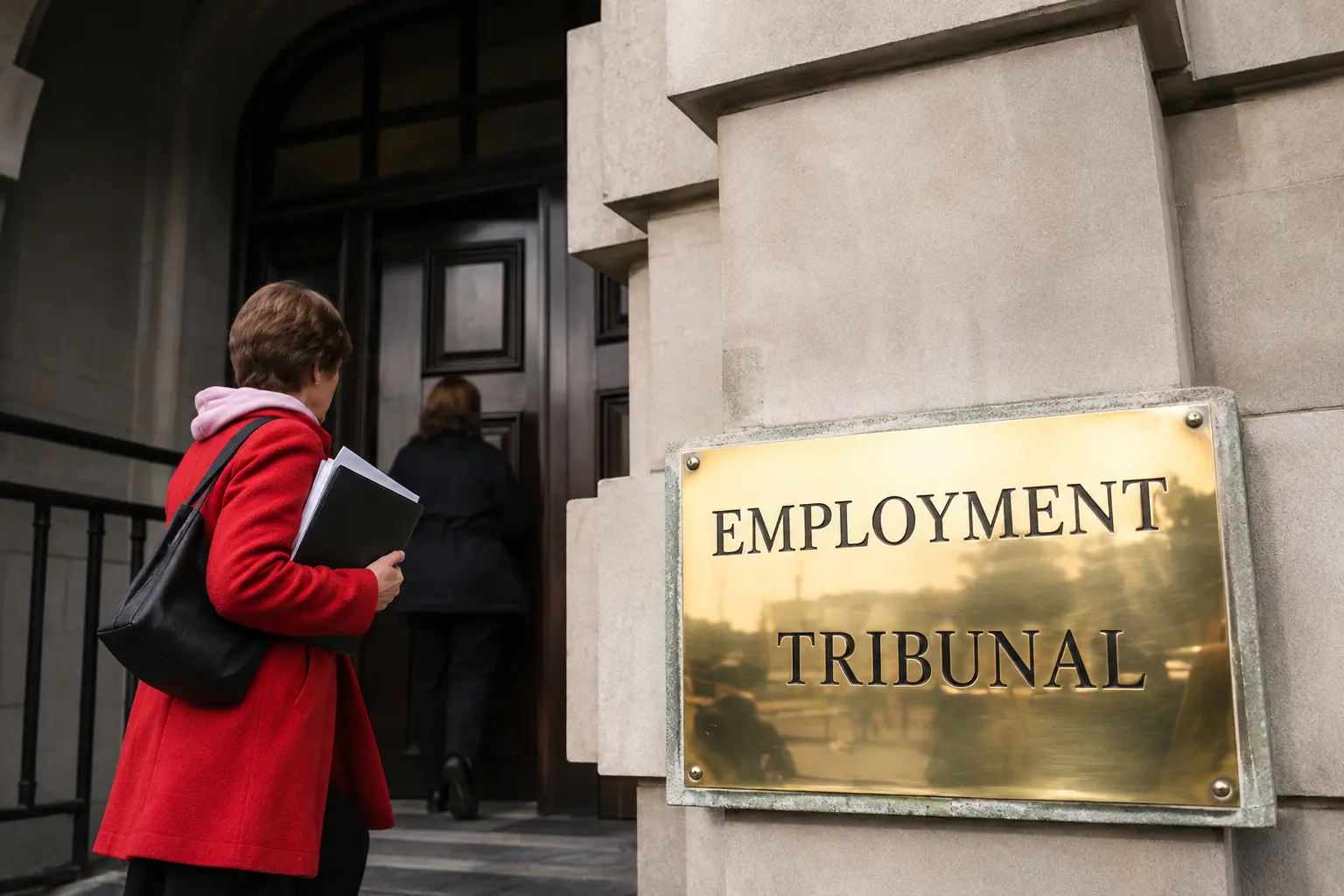

The Employment Appeal Tribunal has reinforced the importance of compliance with case-management directions, ruling that employment proceedings may be struck out where repeated attempts to clarify a claimant’s case have failed and a fair hearing is no longer possible.
What did the Employment Appeal Tribunal decide?
In A Byczko v Manchester University NHS Foundation Trust [2026] EAT 167, handed down on 2 November 2026, the Employment Appeal Tribunal dismissed the claimant’s appeal against an earlier Employment Tribunal decision to strike out her claims.
The judgment was delivered by Andrew Burns KC, Deputy Judge of the High Court, following a hearing on 7 October 2026. The claimant appeared in person, while the respondent was represented by Louise Quigley, instructed by HF Ltd.
The appeal concerned the Employment Tribunal’s decision to strike out claims involving disability discrimination, failure to make reasonable adjustments, constructive unfair dismissal, automatic unfair dismissal for whistleblowing and whistleblowing detriment.
The central question was whether the Employment Tribunal had acted lawfully and proportionately after repeated attempts to establish the factual and legal issues in the proceedings had failed.
“Strike-out remains a last resort and not a short cut.”
Employment Appeal Tribunal, Byczko v Manchester University NHS Foundation Trust [2026] EAT 167
The EAT concluded that the Employment Tribunal had correctly applied the relevant legal principles and was entitled to find that further procedural assistance would not produce a fair and manageable trial.
What was the background to the employment dispute?
Ms Byczko worked as a part-time theatre nurse at Manchester University NHS Foundation Trust between 2017 and 2022. Following periods of ill health and surgery in 2020, she returned to work and raised concerns about undertaking manual handling duties.
She subsequently moved into a fixed-term clinical adviser position within the Trust’s Covid-19 response team. In late 2021, she raised informal complaints concerning her manager and later submitted a formal grievance in January 2022 against her second-line manager.
The claimant resigned in March 2022 and commenced Employment Tribunal proceedings on 14 June 2022. Her claims included disability discrimination, failure to make reasonable adjustments, constructive unfair dismissal, automatic unfair dismissal for whistleblowing and whistleblowing detriment.
The respondent explained that it could not provide a proper response because the factual allegations and matters relied upon in support of the individual complaints were unclear. It therefore requested further particulars.
The Employment Tribunal subsequently held several preliminary hearings in an attempt to identify the claims and establish the issues that would need to be determined at a final hearing.
- Ms Byczko worked at Manchester University NHS Foundation Trust as a part-time theatre nurse and later in a fixed-term clinical adviser role.
- The claimant resigned from her employment.
- The claimant commenced Employment Tribunal proceedings.
- A preliminary hearing considered how the parties could clarify the claims and identify the issues.
- Employment Judge Ross began preparing a draft List of Issues to help establish the claims.
- The Tribunal ordered the claimant to review and amend the draft List of Issues, warning that non-compliance could result in strike-out.
- The Employment Tribunal’s strike-out judgment was sent to the parties.
- The appeal was heard by the Employment Appeal Tribunal.
- The Employment Appeal Tribunal dismissed the appeal.
Why were the original claims struck out?
The Employment Tribunal’s principal difficulty was identifying the precise factual and legal issues arising from the claimant’s original ET1 claim form and continuation sheet.
Although it was possible to identify certain categories of complaints, the Tribunal found that the factual allegations and legal ingredients of those complaints were difficult to distinguish within the extensive narrative material.
The Tribunal attempted to address these difficulties through several preliminary hearings, case-management directions and opportunities for the claimant to provide additional information.
Employment Judge Ross went further by preparing a detailed, 10-page draft List of Issues. It attempted to identify the alleged protected disclosures, detriments, complaints supporting constructive dismissal and alleged failures to make reasonable adjustments.
The claimant was directed to review the document and identify any inaccuracies. However, rather than amending the draft in the required manner, she submitted a separate 37-page document entitled “Claimant’s List of Complaints and Issues” on 5 June 2024.
The document did not comply with the Tribunal’s directions. It introduced additional material, expanded the alleged protected disclosures and detriments, and made the factual and legal issues more difficult to identify.
The Employment Tribunal concluded that it could not conduct a fair trial without knowing precisely what claims the respondent was required to answer. It also considered whether further hearings, disclosure orders or other case-management measures could resolve the difficulties.
Having concluded that no realistic alternative would allow the proceedings to progress fairly, the Tribunal struck out the claims under rule 37(1)(c) of the Employment Tribunal Rules of Procedure 2013.
What is the Tribunal’s duty to assist litigants in person?
A significant part of the EAT judgment concerned the extent to which Employment Tribunals must assist individuals who represent themselves, particularly where disability or other difficulties affect their ability to participate in proceedings.
Andrew Burns KC acknowledged that tribunals have a duty to conduct proceedings fairly and may take reasonable steps to clarify the issues. This can involve asking questions, explaining procedural requirements and assisting an unrepresented party in identifying the nature of their claims.
However, the judgment emphasised that Employment Tribunals operate within an adversarial system. Their responsibility is to remain impartial and determine the disputes presented by the parties, rather than construct a legal case on behalf of one side.
The EAT referred to established authorities, including McNicol v Balfour Beatty Rail Maintenance Ltd [2002] IRLR 711, Woodrup v London Borough of Southwark [2003] IRLR 111 and Moustache v Chelsea and Westminster NHS Foundation Trust [2025] ICR 1231.
The judgment also considered the importance of a List of Issues as a case-management tool. Such a list helps identify the matters requiring determination, defines the scope of disclosure and assists the preparation of factual and expert evidence.
Nevertheless, the EAT made clear that a formal List of Issues is not mandatory in every case. A straightforward dispute may proceed without one. In more complex proceedings, however, the parties and the Tribunal must have a sufficiently clear understanding of the claims being pursued.
The judgment further highlighted that tribunals must consider the impact of repeated preliminary hearings on other litigants waiting for their own cases to be heard. The overriding objective requires proportionate case management and the efficient use of limited tribunal resources.
Were reasonable adjustments adequately considered?
The claimant argued that the Employment Tribunal had failed to make adequate reasonable adjustments to accommodate her asserted disabilities and difficulties in participating in the proceedings.
She had requested several procedural adjustments, including email communications, remote hearings, additional time to prepare responses, written decisions and orders, short breaks during hearings and documents in Microsoft Word format.
The EAT examined the procedural history and found that the Employment Tribunal had taken considerable steps to accommodate these requests.
These included extending deadlines, providing written communications, arranging remote hearings, allowing breaks, extending hearing time estimates, providing documents in Word format and permitting further written submissions. The possibility of an intermediary was also explored.
The Employment Tribunal had additionally adopted an extended written process to help identify the issues, rather than relying exclusively on oral discussions that had previously proved unsuccessful.
Andrew Burns KC concluded that the claimant had not identified an additional reasonable adjustment that would have overcome the difficulties preventing the claims from progressing to a fair trial.
The EAT therefore rejected the argument that the Employment Tribunal had failed to make reasonable adjustments and dismissed this ground of appeal.
Why was the appeal dismissed?
The claimant challenged several aspects of the strike-out decision, arguing that the Employment Tribunal should have imposed its own List of Issues, had not properly assessed the seriousness of her non-compliance and could have adopted alternative case-management arrangements.
The EAT rejected these arguments after considering the procedural history and the applicable legal principles governing strike-out.
It confirmed that the decision to strike out a claim involves a two-stage assessment. First, the Tribunal must establish whether one of the recognised grounds for strike-out has been satisfied. Secondly, it must consider whether striking out is just and proportionate in all the circumstances, including whether a less severe measure would be sufficient.
The EAT found that the Employment Tribunal had correctly applied this approach. The claimant had been given repeated opportunities to clarify the claims and had received warnings about the consequences of failing to comply with its orders.
The Tribunal was also entitled to conclude that alternative arrangements, including multiple staged final hearings, would be impractical and disproportionate. Without a clear understanding of the claims, the respondent could not properly prepare its response, disclosure or witness evidence.
The EAT further rejected the argument concerning the claimant’s alleged second claim. It concluded that the documents submitted in December 2022 were proposed amendments to the original claim rather than a separate claim. The amendment application could properly be considered once the original claims had been clarified.
Having found no error of law in the Employment Tribunal’s decision, Andrew Burns KC dismissed the appeal in its entirety.
What does the ruling mean for employment law?
The decision provides important guidance on the balance between assisting unrepresented claimants and maintaining fair, proportionate and efficient employment proceedings.
For Employment Tribunals, the judgment reinforces the importance of identifying the issues at an early stage, particularly in complex discrimination and whistleblowing claims. Judges may provide assistance and make procedural adjustments, but they are not required to repeatedly reconstruct a party’s case where reasonable opportunities to clarify it have already been provided.
For employers and their legal representatives, the decision highlights the importance of ensuring that claims are sufficiently particularised before proceedings move towards disclosure, witness evidence and final hearings.
For claimants, including those representing themselves, the judgment underlines the importance of engaging with case-management directions and understanding the issues that must be addressed for their claims to proceed.
Importantly, the EAT stressed that this decision should not be interpreted as permission for tribunals to routinely strike out difficult or complex cases. Strike-out remains a last resort, and tribunals should normally attempt to clarify the issues through appropriate preliminary hearings before considering such an outcome.
The broader message is that procedural fairness must operate in both directions. Tribunals must support access to justice while ensuring that proceedings remain manageable and that other litigants are not unfairly disadvantaged by disproportionate delays.
Frequently asked questions
What was the decision in Byczko v Manchester University NHS Foundation Trust?
The Employment Appeal Tribunal dismissed Ms Byczko’s appeal and upheld the decision to strike out her employment claims after repeated failures to clarify the issues and comply with case-management directions.
Why did the Employment Tribunal strike out the claims?
The claims were struck out because the Tribunal concluded that the factual and legal issues could not be identified sufficiently to allow a fair trial, despite extensive judicial assistance and repeated opportunities to clarify the proceedings.
Does an Employment Tribunal have to prepare a List of Issues for an unrepresented claimant?
No. A tribunal may assist an unrepresented claimant in clarifying their case, but it must remain impartial and cannot formulate or construct a party’s legal case on their behalf.
What reasonable adjustments were considered in this case?
The adjustments included additional time, written communications, remote hearings, breaks, Word-format documents, further written submissions and consideration of an intermediary.
Is strike-out appropriate whenever a claimant fails to comply with Tribunal directions?
No. Strike-out is a last resort. The Tribunal must assess whether a recognised ground for strike-out exists and whether the decision is just and proportionate, including whether less severe measures could address the problem.
What happened to the claimant’s alleged second claim?
The EAT found that the documents submitted in December 2022 represented proposed amendments to the original claim rather than a separate claim. The amendment application could be considered once the original claims had been clarified.