
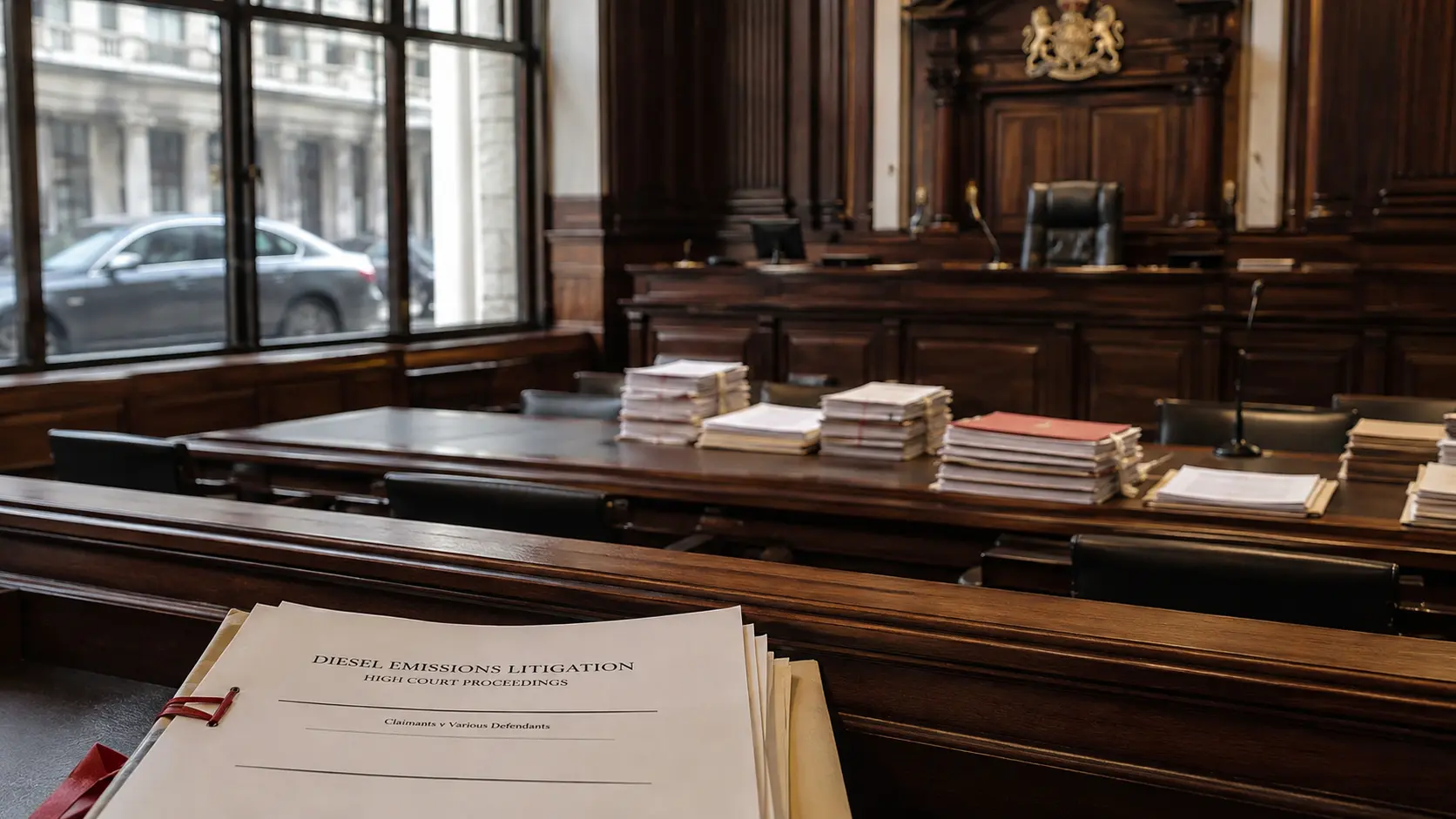

High Court rejects most allegations but finds limited defeat devices involving Mercedes and Peugeot-Citroën
Mercedes-Benz emissions judgment: The High Court has rejected most allegations that major car manufacturers used prohibited emissions defeat devices in diesel vehicles, while making limited findings against Mercedes-Benz and Peugeot-Citroën.
Lady Justice Cockerill handed down the judgment on 10 July 2026 in Various Claimants v Mercedes-Benz Group AG and Others [2026] EWHC 1753 (KB), following the PDD Trial in the Pan-NOx Emissions Group Litigation. The case was heard in the King’s Bench Division of the High Court.
The litigation concerns claims brought on behalf of millions of diesel vehicle owners against major vehicle manufacturers. The PDD Trial focused on allegations that vehicles complying with Euro 5 and Euro 6(b) emissions standards contained prohibited ‘defeat devices’ contrary to the requirements of Regulation (EC) No 715/2007.
The trial examined sample vehicles from five lead defendant manufacturers: Mercedes-Benz, Ford, Peugeot/Citroën, Renault and Nissan. The court considered allegations concerning the design and calibration of three emissions-control technologies: exhaust gas recirculation, lean NOx traps and selective catalytic reduction. Claimants advanced around 40 different types of alleged defeat device.
The court rejected all of the defeat device allegations brought against Ford, Nissan and Renault. Those findings removed the allegations of regulatory breach advanced against those three manufacturers in the trial.
The position was different for Mercedes-Benz and Peugeot-Citroën. The court rejected all but one of the allegations advanced against each manufacturer. It found a prohibited defeat device in relation to a particular exhaust gas recirculation device in the original calibration of one Mercedes-Benz sample vehicle. The judgment records that the relevant calibration had subsequently been removed from affected vehicles through a software update.
The court also found a prohibited defeat device relating to an aspect of fuel injection calibration in the Euro 5 Peugeot-Citroën sample vehicles. The findings against both manufacturers were therefore limited to specific aspects of the vehicles and allegations considered during the trial.
A central issue in the case was the legal meaning of a ‘defeat device’ under Article 3(10) of Regulation (EC) No 715/2007. Lady Justice Cockerill concluded that the relevant device must sense one or more parameters of the test, including its boundary, and objectively operate with the purpose of making the emissions-control system work more effectively when it detects that the vehicle is undergoing a test cycle than during out-of-test driving.
The court described this as the ‘cycle recognition defeat device’ approach. It rejected broader interpretations advanced by the claimants and concluded that this interpretation provided the workable approach to the statutory language, context and purpose of the emissions rules.
The judgment also considered the effect of post-Brexit European case law. Lady Justice Cockerill followed the Court of Justice of the European Union’s decision in CLCV, Case C-693/18, but declined to follow certain aspects of the later GSMB Invest, Case C-128/20 decision. The judgment states that the latter decision contained factual and legal difficulties and was reached on a substantially less detailed factual and expert evidence base than was available to the High Court in the Pan-NOx trial.
The court further addressed whether individual claimants could bring civil claims arising from emissions breaches. It concluded that the statutory emissions-regulation scheme requires the creation of a private law right of action for individual claimants. However, the court also held that the existence of a prohibited defeat device does not, by itself, establish a breach of a claimant’s contract with a vehicle dealership. Any contractual breach would have to be established on the evidence.
The judgment followed a 13-week process involving extensive factual and expert evidence, vehicle testing, documentary disclosure and legal submissions. Further hearings are expected to consider the consequences of the judgment for the lead defendants and the wider Pan-NOx litigation.
The ruling therefore provides the High Court’s findings on the liability issues examined in the PDD Trial while leaving further questions in the wider litigation to be addressed by the court.