

For the British legal profession, 2026 marks a definitive “coming of age” for domestic privacy regulation. The commencement of the Data (Use and Access) Act 2025 (DUAA) on 5th February has finally severed the remaining umbilical cords to the rigid Brussels model, replacing them with a framework that prioritises “reasonableness” and “proportionality.” However, for solicitors and legal practitioners, this shift from prescriptive rules to principle-based judgment creates a new kind of risk: the risk of misinterpreting flexibility for leniency.
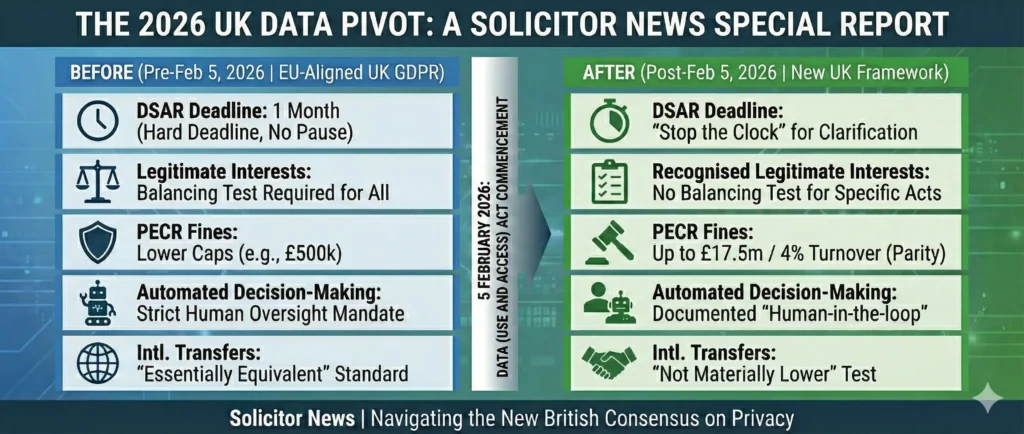
As we examine the current state of data protection law in the UK, it is clear that we are no longer in a transitional phase. We are in a regime of “managed divergence.” The DUAA has introduced several high-impact changes that demand an immediate review of firm-wide compliance protocols. Perhaps most significant for litigators and compliance officers is the statutory “stopping the clock” provision for Data Subject Access Requests (DSARs). By codifying the ability to pause the one-month deadline while seeking clarification, the Act offers a pragmatic shield against the “weaponised DSAR” often seen in contentious employment or personal injury cases. Yet, the burden remains on the controller to prove that such clarification is “reasonably required”, a threshold that will undoubtedly become a new battleground in the courts.
Beyond the Red Tape: The Rise of “Recognised Legitimate Interests”
One of the most profound shifts in the UK GDPR landscape this year is the introduction of “recognised legitimate interests” (RLI). By removing the requirement to perform a balancing test for specific activities such as reporting crimes, safeguarding vulnerable individuals, or responding to emergencies, the government has cleared a path for smoother data sharing. But for the private sector, the message is more nuanced. While the Act aims to reduce “consent fatigue” by relaxing cookie requirements for statistical and functional purposes, the Information Commissioner’s Office (ICO) has simultaneously gained sharpened teeth.
The PECR (Privacy and Electronic Communications Regulations) fine limit has finally been brought into parity with the UK GDPR, reaching up to £17.5 million or 4% of global turnover. This is not a coincidence. It is a clear signal that while the government is easing the administrative burden of data processing, the regulator will punish systemic negligence with unprecedented severity. We are seeing a “fewer but heavier” enforcement trend; as of February 2026, the ICO’s high-profile investigations into AI-driven data misuse underscore that the era of minor reprimands is over.
The AI Frontier and the “Adequacy” Tightrope
The interplay between the UK’s liberalised Automated Decision-Making (ADM) rules and the international standard is a critical focal point for 2026. The DUAA has effectively lowered the bar for using AI-driven tools in recruitment and performance monitoring, provided human oversight is maintained, and special category data is not involved. However, for UK firms servicing EEA clients, the “adequacy” status remains the sword of Damocles.
The new “Data Protection Test” for international transfers, which asks whether the destination country’s protection is “not materially lower” than the UK’s, is a pragmatic departure from the EU’s “essentially equivalent” standard. While this eases transfers to emerging markets, solicitors must ensure their Transfer Impact Assessments (TIAs) are robust enough to withstand European scrutiny. Any divergence perceived as too radical could trigger a revocation of the UK’s adequacy decision, forcing a regressive return to Standard Contractual Clauses (SCCs) that would complicate cross-border legal services.
The Solicitor’s Mandate: From Compliance to Governance
The role of the Data Protection Officer (DPO) has also undergone a subtle but vital transformation. Under the new regime, the focus has shifted from mere record-keeping to a “senior management accountability” model. The ICO now expects firms to demonstrate a “culture of privacy” that begins at the Board level. It is no longer enough to have a static privacy policy; firms must show active, risk-based governance.
For the modern solicitor, advising on data protection law in the UK in 2026 requires a hybrid skill set. One must be a black-letter lawyer to navigate the statutory changes, a technologist to understand the implications of AI training sets, and a diplomat to balance the divergent requirements of London and Brussels. As we look toward the 19 June 2026 commencement of the new statutory right for individuals to complain directly to controllers, the window for firms to “get their house in order” is closing.
The 2026 Practitioner’s Compliance Checklist
To ensure a practice remains ahead of the curve, we recommend immediate action on the following:
- Update DSAR Protocols: Review internal workflows to incorporate the “stop the clock” mechanism for clarification requests. Ensure staff understand the new “reasonable and proportionate” search standard to avoid over-disclosure.
- Audit Automated Systems: If your firm or your clients use AI for decision-making (recruitment, credit checks, etc.), ensure that a “human-in-the-loop” safeguard is not only present but documented.
- Refresh Legitimate Interest Assessments (LIAs): Identify processing activities that now fall under “Recognised Legitimate Interests” to streamline your Record of Processing Activities (ROPA).
- Prepare for Direct Complaints: By June 2026, you must have a formal, accessible process for data subjects to complain to you before they escalate to the ICO. Draft your response templates now to meet the 30-day acknowledgement deadline.
- Re-evaluate International Transfers: Use the “not materially lower” test for new data sharing agreements, but maintain “essentially equivalent” standards for EEA-linked data to preserve adequacy.
In this new era, the most successful practices will be those that treat data not as a liability to be managed, but as a core asset to be protected with the same rigour as the client’s own legal privilege.
