
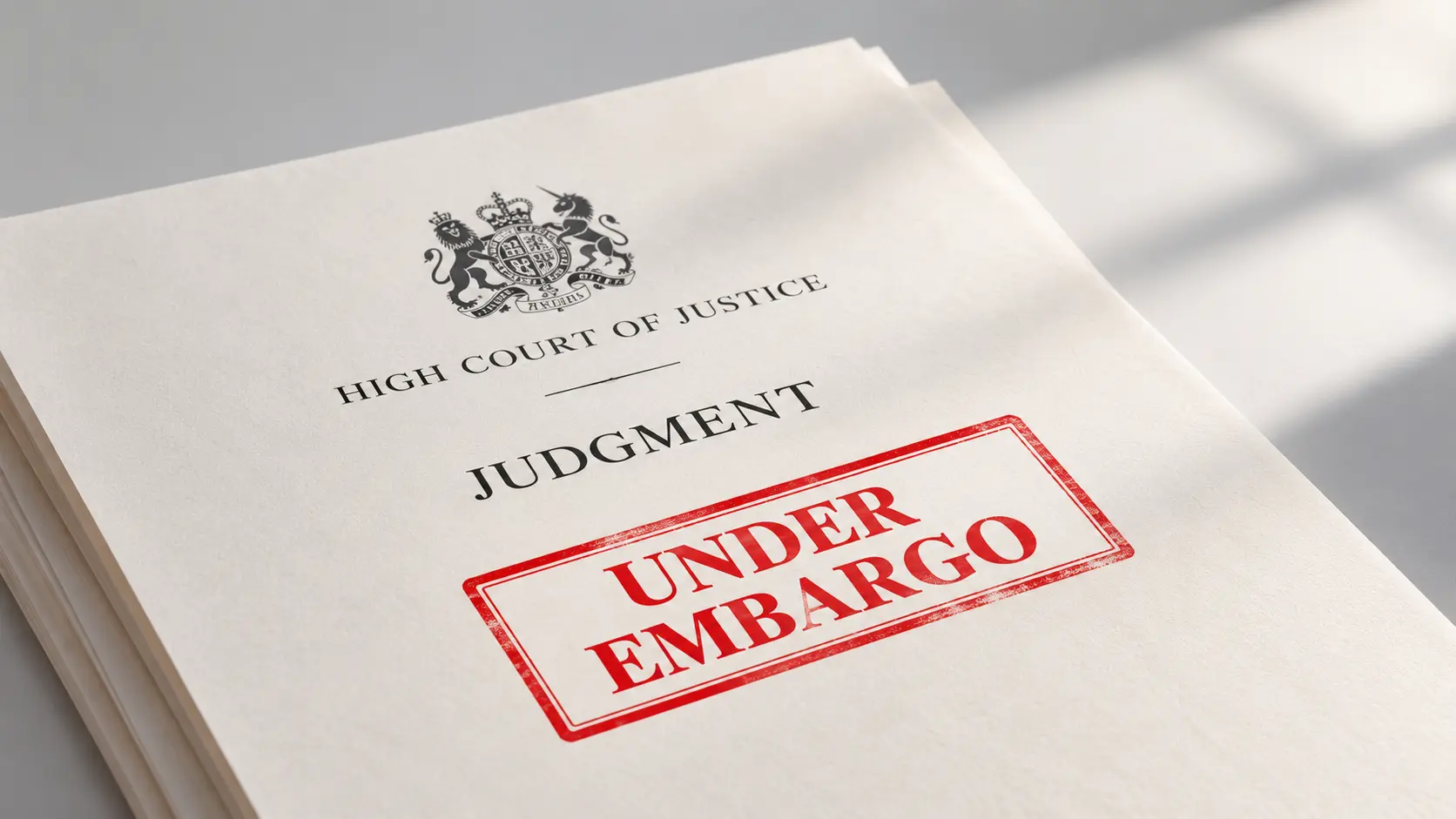

A High Court ruling has underlined the strict limits on sharing draft judgments before they are formally handed down, after a company director disclosed the outcome of a case to his accountant despite having been warned to keep it confidential.
What did the High Court decide?
In Car-Wizard Limited v Vixen Surface Treatments Limited [2026] EWHC 2739 (Comm), handed down on 26 October 2026, HHJ Paul Matthews, sitting as a Judge of the High Court, considered a breach of the embargo imposed on a draft judgment in the parties’ commercial dispute.
The court found that Oliver Birrell, Car-Wizard Limited’s sole director and shareholder, had disclosed the substance of the draft liability judgment to the company’s accountant before the judgment was made public. The judge decided that Mr Birrell was responsible for the breach, but that it was unnecessary to pursue contempt proceedings. He admonished Mr Birrell instead.
How was the embargo breached?
The underlying commercial dispute had resulted in earlier judgments on liability, damages and consequential matters. The ruling addressed a separate issue: information shared before the liability judgment was formally handed down.
According to the evidence considered by the court, Car-Wizard’s solicitor had warned Mr Birrell that the draft judgment and its contents had to remain confidential. After receiving the draft, Mr Birrell emailed his accountant on 24 March 2026 and stated that the company had won the claim, adding that compensation and costs were still to be finalised.
Mr Birrell explained that he was seeking accounting information about a personal loan he had made to the company during the litigation. He said he had not appreciated that telling the accountant the outcome of the claim breached the embargo. The accountant later confirmed that the email had not been shared further.
- Mr Birrell received the draft judgment after being warned to keep it confidential.
- He emailed the accountant and disclosed that the company had won the claim.
- The solicitor raised the breach with Mr Birrell, and counsel informed the court.
- The liability judgment was handed down.
- HHJ Matthews delivered the ruling on the embargo breach and admonished Mr Birrell.
Why are judgment embargoes important?
The judge reiterated that draft judgments are circulated under embargo for limited purposes: allowing parties to identify possible errors, prepare submissions and orders concerning consequential matters, and get ready for publication. They are not provided for general disclosure or discussion.
The restriction extends beyond sharing the complete draft. It also covers extracts and the substance or result of the judgment. The court emphasised that the rules apply to third parties, including professional advisers, unless the court expressly gives permission for disclosure.
HHJ Matthews also stressed that a breach can be a serious legal matter and may lead to contempt proceedings. A potential breach should be reported to the court as soon as it is discovered. In this case, the judge considered that the solicitor and counsel had acted properly by promptly bringing the disclosure to the court’s attention.
Why did the court not pursue contempt proceedings?
The court considered several circumstances when deciding how to respond. The disclosure appeared to have been a single communication, the accountant did not pass the information on, and there was no apparent actual damage. Mr Birrell and his solicitor provided explanations and apologised to the court.
Those factors did not make the breach insignificant. The judge explained that embargoes support the efficient administration of justice by allowing parties to prepare for the formal hand-down of a judgment and deal with consequential matters in an orderly way.
“In another case, the court may not be so merciful.”
HHJ Paul Matthews, [2026] EWHC 2739 (Comm)
The judge concluded that Mr Birrell should have checked with his solicitor before disclosing information to his accountant. Although contempt proceedings were considered, the judge ultimately decided that an admonition was sufficient in the circumstances.
What should solicitors and clients do?
The ruling offers a practical reminder for solicitors handling reserved judgments. Advising a client that a draft is confidential may not be enough if the client does not understand that the restriction also prevents them from discussing the outcome with people they regard as needing to know, including accountants and other professional advisers.
HHJ Matthews said lawyers should explain clearly who may not be told about an embargoed judgment, make sure clients understand the limits, and tell them to seek advice whenever they are unsure. If a client is unwilling or unable to comply with the embargo, the judge said lawyers should not disclose the judgment’s contents to them.
For clients, the central lesson is straightforward: do not share a draft judgment or its result with anyone before hand-down unless the court has expressly authorised the disclosure. A legitimate practical need, including obtaining professional advice, does not by itself remove the restriction.
Frequently asked questions
What is a judgment embargo?
A judgment embargo is a legal restriction that keeps a draft judgment and its substance confidential before the judgment is formally handed down, subject to any permission expressly granted by the court.
Can a party tell their accountant the result of an embargoed judgment?
Not unless the court expressly permits it. The ruling confirms that the restriction can cover disclosure to professional advisers, even where the information is shared for a practical business purpose.
Was Oliver Birrell found to have breached the embargo?
Yes. HHJ Matthews concluded that Mr Birrell was responsible for disclosing the outcome to his accountant before the judgment was handed down.
Was Mr Birrell prosecuted for contempt of court?
The judge considered whether to pursue contempt proceedings but decided that this was unnecessary in the circumstances. Mr Birrell was admonished.
What should a client do if they need to share information from a draft judgment?
They should contact their solicitor and seek the court’s express permission where disclosure is needed. They should not assume that a professional or confidential relationship creates an exception to the embargo.