
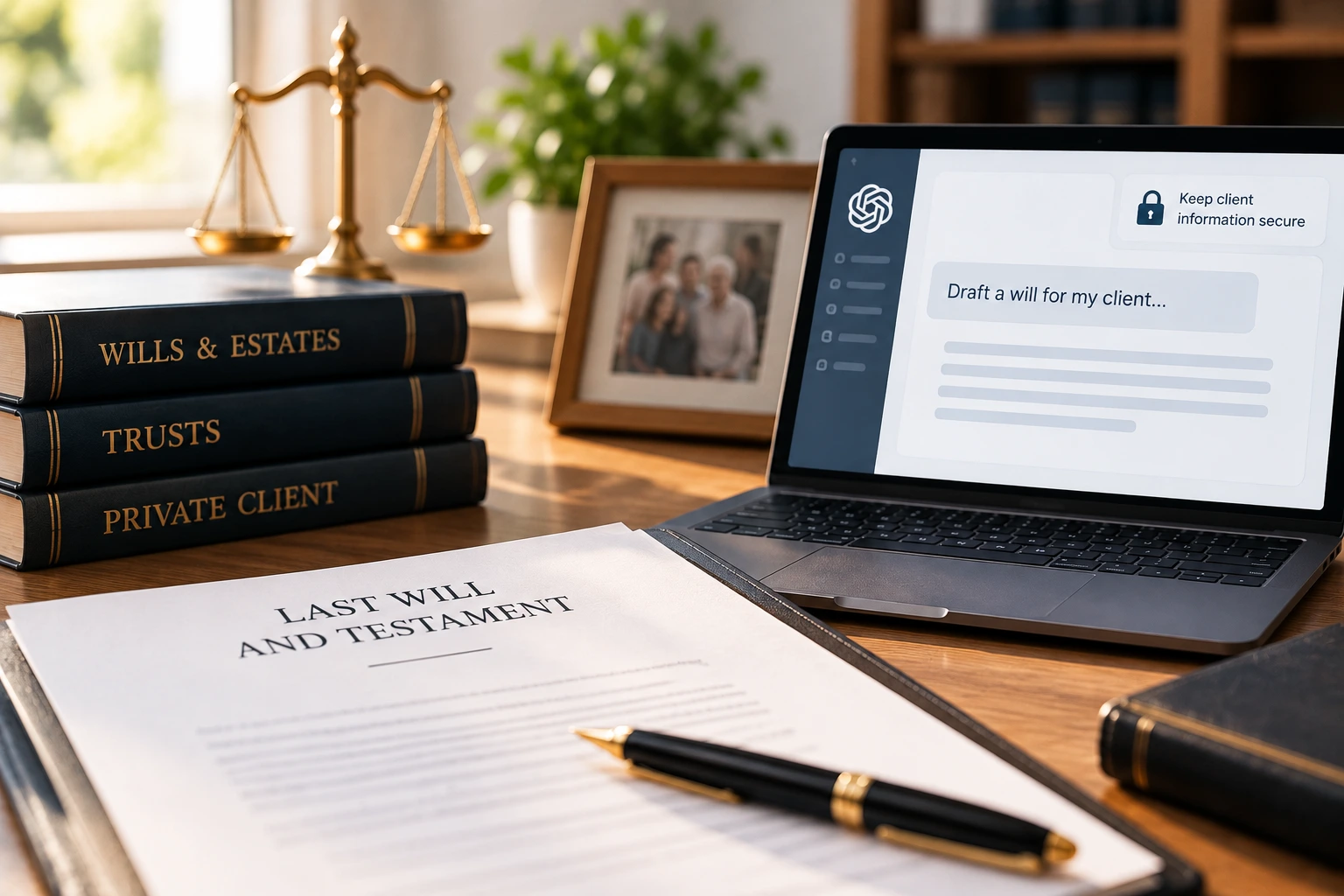

The SRA’s AI warning notice cites four cases, and every one of them is a litigation decision. Litigation, though, is where an AI error is most likely to be caught within weeks. Andy Hitchon of LEAP Legal Software argues the notice lands hardest somewhere quieter.
In private client work, not litigation. Every case the SRA’s warning notice of 17 August 2026 cites is a litigation case, but litigation is where mistakes surface early: the other side checks the citation and a judge reads the bundle. A private client file has no opposing party reading the draft, so an error in a will or a trust can sit on the file for a decade before anyone has a reason to look hard at it.
- All four cases the notice cites are litigation decisions, yet litigation is where an AI error is caught fastest and most publicly.
- A private client error is stored rather than caught. A trust clause can read perfectly well and still create the wrong interest.
- Files are read back years later under a Larke v Nugus request, an HMRC enquiry or a beneficiary challenge, by which point the fee earner may have left the firm.
- Estate files hold personal data on people who never instructed the firm, so data protection duties reach further than the duty of confidentiality.
- The SRA’s effective supervision guidance, updated 12 June 2026, puts ultimate responsibility for AI-assisted legal services on an authorised individual.
On 17 August 2026, the SRA published a warning notice on the misuse of AI, just over nine weeks after updating its effective supervision guidance. Behind it sit 42 reports of potential AI misuse received between July 2025 and July 2026, and every case the notice cites is a litigation case.
The notice could easily be read as a warning relating only to advocates and bundles. In reality it lands hardest in private client, which, for all that these tools can genuinely do here, is the perfect breeding ground for both of the concerns the notice names. Accuracy and hallucinations sit at one end and data security at the other, and they create very different problems.
Why does an AI error survive longer in private client work?
Litigation is where mistakes get caught early, because the other side checks the citation and a judge reads the bundle, so the error surfaces within weeks and usually in public. Private client has no other side reading the draft.
The client trusts the legal advice rather than testing it, and nothing in the work itself gives way at the point it is produced. A trust clause can read perfectly well and still create the wrong interest, a generated meeting summary reads exactly like an attendance note, and an IHT figure looks like a figure whether or not anyone can show how it was reached. The work looks finished, so the error is stored rather than caught. In a will, that error may not surface until the testator has died and can no longer be asked what they meant. In a trust, it can sit untested for years until an appointment, a ten-year charge or the death of a life tenant forces somebody to read the clause properly.
The file is eventually read back by somebody with a reason to look hard, whether that is a request under Larke v Nugus [2000] WTLR 1033, an HMRC enquiry or a beneficiary questioning why a trustee exercised a power the way they did. That can be a decade later, by which point the fee earner will not remember the detail and may have left the firm, so the file has to answer for itself. A litigator might be able to point back to last spring’s court file, but here the file may have to survive a transfer, a change of system and a change of staff. Paragraph 7.2 of the SRA Code also requires you to be “able to justify your decisions and actions in order to demonstrate compliance with your obligations under the SRA’s regulatory arrangements”.
That makes supervision the main check before an error is stored. The SRA’s effective supervision guidance, which covers how firms oversee work delegated to staff and was updated on 12 June 2026 with a section on AI, requires firms to ensure that an authorised individual “retains ultimate responsibility for any legal services delivered with AI assistance”. In practice, that puts a task handed to a tool on the same footing as one handed to a less experienced colleague, which is worth bearing in mind for LPA work in particular, where so much is prepared by paralegals and support staff.
Why is confidentiality the exposure you cannot undo?
The second concern is not about what ends up on the file, but about what leaves the firm, and it is the harder of the two because an inaccuracy can be found and corrected whereas this cannot. The Upper Tribunal observed in UK v Secretary of State for the Home Department [2026] UKUT 81 (IAC) that to put client letters and Home Office decision letters “into an open source AI tool, such as ChatGPT, is to place this information on the internet in the public domain”, and the SRA’s warning notice adds that legal professional privilege “may be permanently waived and unable to be recovered” as a result. Our earlier report on that notice sets out how the same risk arises in intake, email and document review across general practice.
It also runs wider than the obvious parts of the practice. A will file records capacity and health information, and sometimes the family circumstances behind why a child has been left out. LPA work is volume work, which means donor and attorney details passing through in quantity. An estate file is the widest of all, holding a great deal of personal data about people who have never instructed the firm, from beneficiary names, addresses and dates of birth through to bank details and sometimes family circumstances nobody intended to put in writing. That matters because the duty of confidentiality under paragraph 6.3 of both SRA Codes is owed to the client, but data protection duties extend to everyone whose information is on the file, so a single estate file can put the private lives of everyone named in it at risk.
Which three records should a firm keep?
So what can firms actually do about these problems? The fix is not technical, and it comes down to three pieces of record-keeping.
- List what AI your team uses, by work type. Not a firm-wide policy, but a one-page note of which tools touch wills, LPAs and estates, including the free one somebody opened in a browser tab and never mentioned, because you cannot supervise a list you do not have.
- Draw the confidentiality line clearly and make sure everybody knows where it sits. A plain rule that names, beneficiary details, asset values and anything about capacity or health do not go into a public AI tool.
- Record the check where it will still be found years from now. Who reviewed the AI-assisted output, against what, and when, kept on the matter file rather than in a policy document nobody opens, because the duty to justify your decisions and actions does not expire.
What is the bottom line?
AI has a place in private client, and nothing in the notice says otherwise. It must be a tool you can answer questions about, which means knowing where the data goes, who reviewed the output and what it was checked against. This has always been the practice area where the file has to speak for the solicitor long after the solicitor is available to speak for it, which is not a new duty at all. It is now simply easier to fail.
- SRA warning notice on the misuse of AI, published 17 August 2026
- SRA guidance on effective supervision, updated 12 June 2026
- UK v Secretary of State for the Home Department [2026] UKUT 81 (IAC), Find Case Law
- SRA Code of Conduct for Solicitors, RELs, RFLs and RSLs
- SRA Code of Conduct for Firms
- Larke v Nugus [2000] WTLR 1033