

Court of Appeal says foreseeability alone did not establish negligence and orders retrial
TfL cycle track claims arising from two cycling accidents must be reconsidered at a fresh hearing after the Court of Appeal found that the trial judge had not properly assessed whether Transport for London (TfL) was negligent.
The Court of Appeal allowed TfL’s appeals in Transport for London v Cairn Young & Anor [2026] EWCA Civ 1095, handed down on 18 August 2026. The court set aside the findings of liability and consequential decisions and remitted both claims for a fresh hearing before a different Circuit Judge.
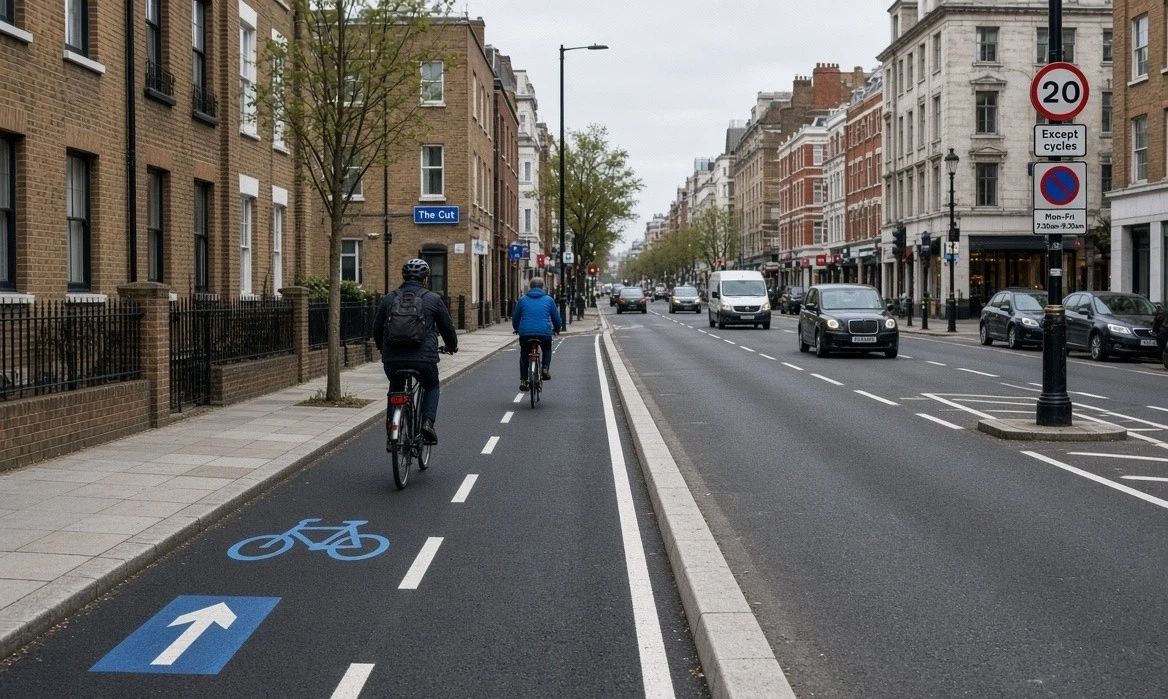
The claims concerned accidents involving Cairn Young and Egon Upitis on a stepped cycle track forming part of Cycle Superhighway 6 on Farringdon Road. Both cyclists had mistaken a raised kerb separating the cycle track from the carriageway for a white road marking. Their bicycles struck the kerb and both cyclists were injured.
At trial, His Honour Judge Hellman found TfL liable after concluding that the design created a reasonably foreseeable risk of injury and that additional measures could reasonably have been taken. He found contributory negligence of 70% for Mr Young and 65% for Mr Upitis.
The Court of Appeal agreed with the trial judge on an important point: TfL owed a common law duty of reasonable care because it had positively created the relevant highway feature. That duty was not limited to careful road users. A cyclist’s own carelessness could affect breach, causation or contributory negligence, but did not by itself remove the duty.
However, the Court of Appeal stressed that foreseeability of harm is not the same as breach of duty. A highway authority that creates a potential hazard is required to take reasonable care; it is not required to eliminate every foreseeable risk.
For solicitors, the key point is the court’s requirement for a full evaluative assessment when determining breach. The relevant considerations include the magnitude of the risk, the seriousness of possible injury, the social utility of the facility, applicable standards and guidance, professional design judgment, accident or complaint history, and the cost, practicality and disadvantages of further precautions.
The Court of Appeal found that the trial judge had moved too quickly from identifying a foreseeable risk to identifying a possible precaution. In particular, the judge had relied materially on the possibility of installing a row of wands along the kerb to create an impassable barrier.
The Court of Appeal said the judge had not sufficiently explained why, considering the high volume of use, the purpose of the stepped cycle track, applicable guidance, previous safety-audit consideration and the consequences of installing wands, reasonable care required TfL to take that additional step.
The court also rejected TfL’s argument that reliance on wands was procedurally unfair. The respondents’ pleaded negligence case was sufficient to encompass the issue, and TfL’s witness had been cross-examined about wands without objection.
The judgment made clear that the decision was fact-specific and did not establish a new legal rule for other claims. The Court of Appeal described the claims as ordinary County Court personal injury claims involving established principles applied to the particular location.
All issues will now be reconsidered at the fresh hearing, including contributory negligence. The Court of Appeal preserved no findings of fact.