
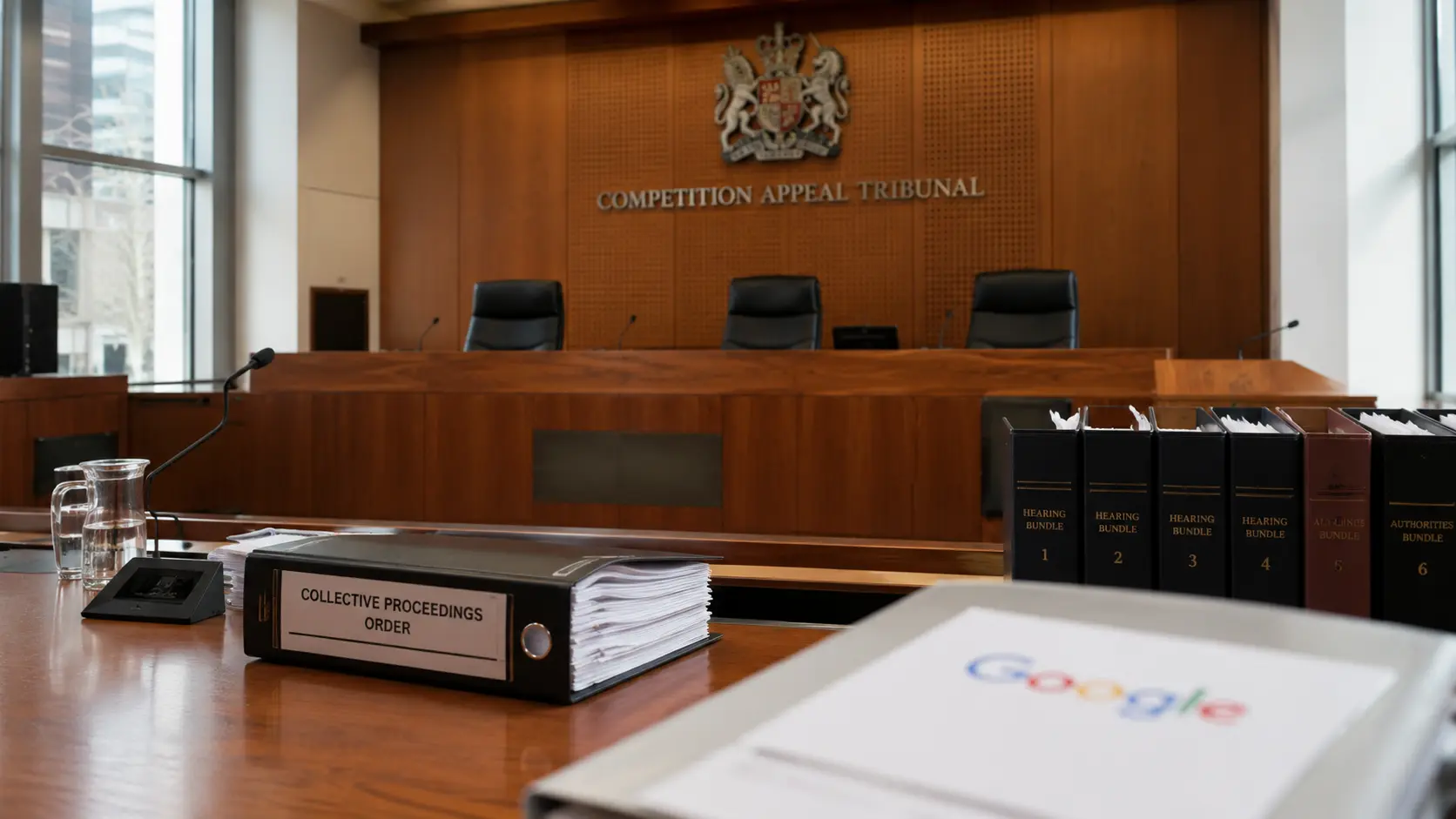

Competition Appeal Tribunal certifies Google advertising claim for opt-out collective proceedings
The Competition Appeal Tribunal (CAT) has granted an opt-out Collective Proceedings Order (CPO) in a competition claim brought by Or Brook Class Representative Limited against several Google companies, allowing the proposed collective proceedings to move forward under section 47B of the Competition Act 1998. The Tribunal concluded that the proposed class representative met the statutory authorisation condition and that the proposed proceedings satisfied the eligibility condition required for certification.
The judgment follows a hearing held on 8 July 2026 concerning an application lodged on 15 April 2025 by Or Brook Class Representative Limited. The proceedings are brought against Alphabet Inc., Google LLC, Google Ireland Limited, Google UK Limited, Google Asia Pacific Pte. Ltd. and Google Commerce Limited. The claim concerns alleged competition law infringements relating to Google’s search advertising services.
In its decision, the Tribunal examined whether the proposed class representative was suitable to conduct the proceedings on behalf of the proposed class and whether the claims were appropriate for collective proceedings. After considering the evidence and submissions from both parties, the Tribunal unanimously concluded that both statutory certification requirements had been met. It therefore granted the application on an opt-out basis, enabling eligible class members to be included automatically unless they choose to exclude themselves.
A significant part of the judgment addressed procedural issues raised by Google concerning the proposed class definition, continuing loss and limitation. Google argued that the description of the class by reference to search advertising services lacked sufficient clarity. The Tribunal rejected that objection, finding that although questions might arise at the margins, the proposed definition was workable. It noted that the proposed class representative had clarified that the claim covered text advertisements and product listing advertisements appearing on Google’s search engine results pages and that Google’s own expert evidence demonstrated it was capable of identifying the proposed class.
The Tribunal also considered the treatment of continuing losses. During the hearing, the proposed class representative accepted that the claim would be limited to losses incurred up to an appropriate point before trial rather than extending beyond judgment. The Tribunal concluded that this approach resolved Google’s principal objection and indicated that the precise cut-off date should be determined through future case management decisions.
The Tribunal also dealt with disputes over limitation. Google argued that parts of the proposed claims were time-barred, with different limitation periods applying to the standalone and follow-on elements of the claim. The proposed class representative accepted that certain periods would need to be reduced for claims other than those governed by Scots law. However, it maintained that claims subject to Scots law raised separate issues concerning prescription, which the parties agreed should be determined at a future case management conference.
While acknowledging that limitation issues were likely to reduce the overall value of the claim, the Tribunal considered that these questions did not prevent certification. Instead, it concluded that the remaining disputes could be managed through the normal case management process. It also directed that the proposed class representative should revise its quantum calculations once the outstanding Scots law issues had been resolved.
Earlier in the judgment, the Tribunal considered several matters relating to funding and governance, including remuneration for Dr Brook as the sole director of the proposed class representative, the role of a consultative panel, cooperation with the class representative in the related Stopford proceedings, the costs incurred to date and the settlement of a carriage dispute. After reviewing the evidence, the Tribunal found that the proposed class representative had acted with the interests of the proposed class in mind when reaching the settlement, while noting that any financial arrangements would remain subject to the Tribunal’s ongoing supervisory jurisdiction where appropriate.
To ensure procedural clarity, the Tribunal ordered the proposed class representative to formalise its positions on class definition, continuing loss and limitation in writing within 14 days of the judgment. The Tribunal stated that the document should record only the positions advanced during the hearing and should not introduce new arguments. Google was given permission to comment solely on whether the written statement accurately reflected what had been said during the hearing.
In its final disposition, the Tribunal unanimously concluded that the proposed class representative satisfied the authorisation condition and that the proposed collective proceedings met the eligibility condition required under the Competition Act 1998. It further ruled that Google was not liable for the costs of the carriage dispute and confirmed that the proposed class representative must comply with the 14-day direction concerning procedural matters.
The Tribunal then granted the application for a Collective Proceedings Order on an opt-out basis. As a result, the proposed competition claim against Alphabet Inc., Google LLC, Google Ireland Limited, Google UK Limited, Google Asia Pacific Pte. Ltd. and Google Commerce Limited will proceed as certified collective proceedings, subject to the directions set out in the judgment.